Get started
From nothing to a gateway
Five steps. Every block below is real output — the project's own rule is that a claim is a measurement or it is removed, and that applies to its documentation too.
-
01Install
Python 3.10–3.13 and git. A GPU — a graphics processing unit — is needed only on the machine that serves; clients need neither.
git clone https://github.com/warith-harchaoui/ai-bunker.git cd ai-bunker python3 -m venv .venv && source .venv/bin/activate pip install -e ".[api]" -
02Find out what you need
Before buying anything. The cheapest answer is often the machine you already own, which is in the catalogue at $0 so that "buy nothing" is a costed option rather than a shrug.
$ ai-bunker recommend --team 2 --model qwen3-coder-next --vision qwen3-vl-8b LOAD MODEL each person decodes 25% of a session, 50% of the team is in session at peak → 95th percentile of Binomial(2, 0.125) = 2 concurrent sequences the machine must sustain 2 sequence(s) above 20 tok/s ✔ BUY Apple MacBook Pro M2 Max 96GB (existing) 90 GiB · 400 GB/s · $0 carries 5 sequences (needs 2) at 20 tok/s each, 27 tok/s alone -
03Configure, and check the claims
cp config/gateway.example.yaml config/gateway.yaml export AI_BUNKER_API_KEY="$(python3 -c 'import secrets; print(secrets.token_urlsafe(32))')" $ ai-bunker doctor [ok ] charter carries operating rules [ok ] 27 rules loaded [ok ] 247 rule assertions pass [ok ] 100% of rules carry evidence [WARN] upstream local answers at http://127.0.0.1:8001/v1 not reachable [ok ] no route leaves this network 12/14 checks passdoctorreports what the deployment actually does, including that a gateway without an API key — an application programming interface key — is open to anyone who can reach it. Open by accident and open on purpose look identical from outside; this is what tells them apart. -
04Serve, and point a client at it
ai-bunker serve                      # localhost:8000

export OPENAI_BASE_URL="http://127.0.0.1:8000/v1"
export OPENAI_API_KEY="$AI_BUNKER_API_KEY"
That is the whole client configuration. Any client that speaks OpenAI now gets the charter, the rule engine and the budget without being configured for them.
The dashboard is at
/gui: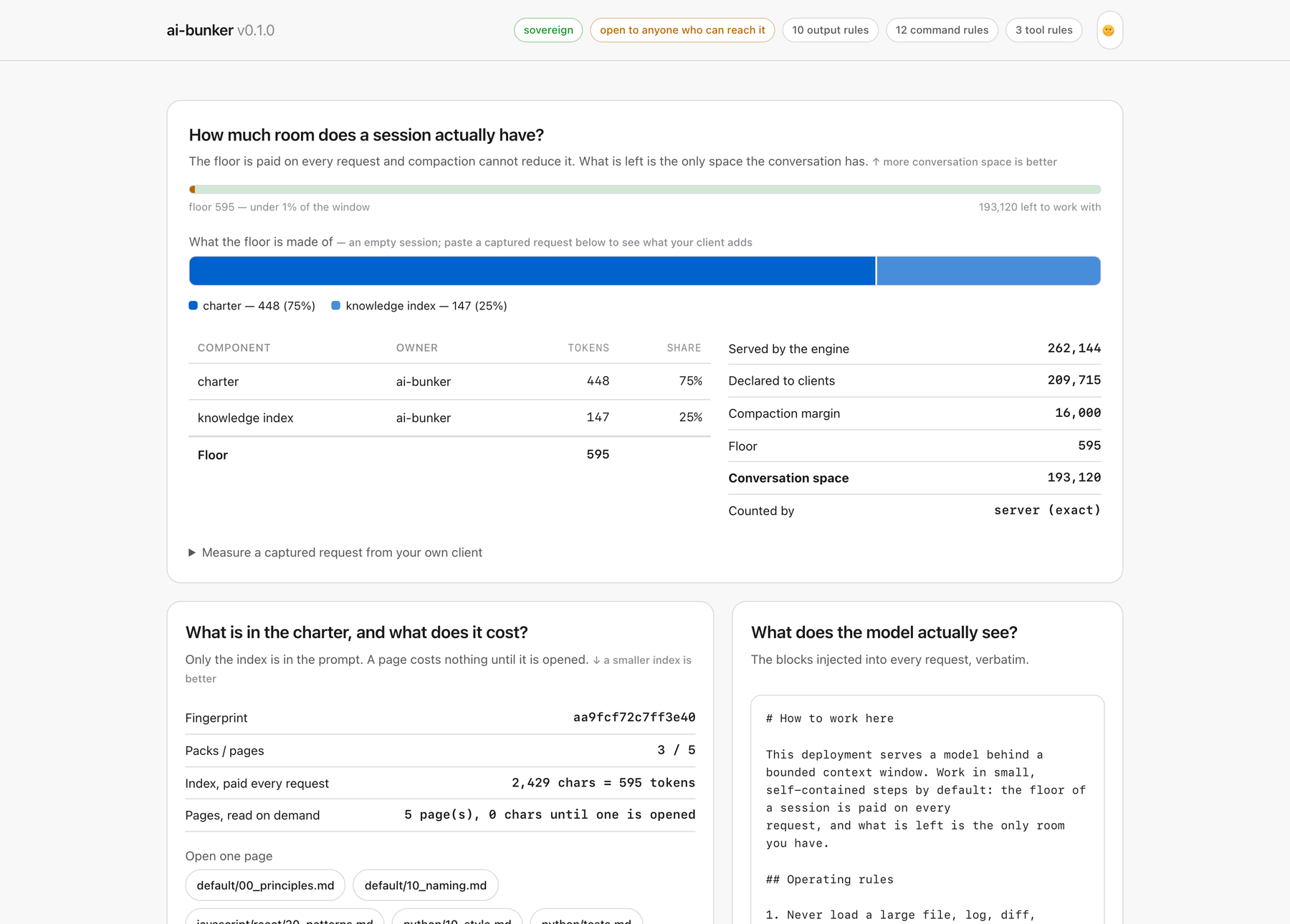
Two bars rather than one: a 300:1 ratio and a composition are two different questions, and one bar cannot carry both. -
05Equip a repository
$ ai-bunker adopt /path/to/project --list
Adopting ai-bunker into /path/to/project:
  + charter/AGENTS.md   (how to work here, injected every request)
  + charter/packs   (the standards pages, read on demand)
  + charter/rules   (the rules, with their own evidence)
  + opencode.json   (points at the gateway)
  + .opencode/plugins/bounded-reads.js   (the one thing the gateway cannot do)
  + .claude/settings.ai-bunker.json   (merge into .claude/settings.json)
  + CLAUDE.md   (what the gateway does to a session)
Nothing is overwritten without
--force. The client kit is deliberately one config and one plugin: everything the gateway can see, the gateway enforces, so a kit carries only what happens before a request exists — bounded reads, no skill injection, compaction thresholds.
Before you depend on it
This is 0.2.0-alpha: a green continuous-integration (CI)
gate, next to projects with years of production use. Command screening applies to
streamed completions as well as atomic ones — a tool call asked for in fragments is
assembled, judged by the same code path, and refused the same way — and
/health reports which guarantees are live
rather than implying all of them are.
And what is still open
-
Counting is
serialised, by a lock and on purpose. The tokenizer probe and the counts
are synchronous calls. They used to run inside asynchronous handlers, and
/healthtook 9.73 seconds against a silent engine; the inbound pipeline now runs in a worker thread and the same stall costs it 0.01 seconds. Two requests still do not count at once — the gateway's shared state has never needed a lock because nothing was ever concurrent, and an availability fix paid for with a data race is not a fix. - The audit log grows without bound. Appended to, never rotated: rotation belongs to whatever already rotates logs on that host, and nothing here will tell you the file is large. In-memory state is bounded, oldest sessions evicted first.
- A request above thirty-two characters per token of served context is refused unread. Screening costs time linearly in what arrives, and a worker thread does not change that — pattern matching holds the interpreter lock. This ceiling is what bounds it, so it applies to every surface that carries a body. About four mebibytes on a 131,072-token engine: roughly thirteen times the largest request that could ever fit, because refusing one that would have fitted is the worse failure.
- Personal data is not screened. The rules cover credentials, prompt injection, dangerous shell commands and tool descriptions — not names, addresses, national identifiers or payment cards. A deployment with an obligation about personal data needs a content inspector; this is a gateway, and the landscape says which tools do that properly.
-
The shell-tool vocabulary is
a default, not a claim to completeness. A gateway cannot know every
client's tool names, so
SHELL_TOOLSis overridable — and a tool it does not recognise is a command it does not screen.
A limitation nobody published is one somebody discovers. The exact bounds are quoted once, where they can be checked against the code: stated limitations, in full →