Landscape
The gateways route.
The guardrails inspect.
Neither counts.
Tools that sit between a coding agent and a model, surveyed 2026-10-19. A tool optimised for a different job is not being criticised — and three of them are better than this project at something named below.
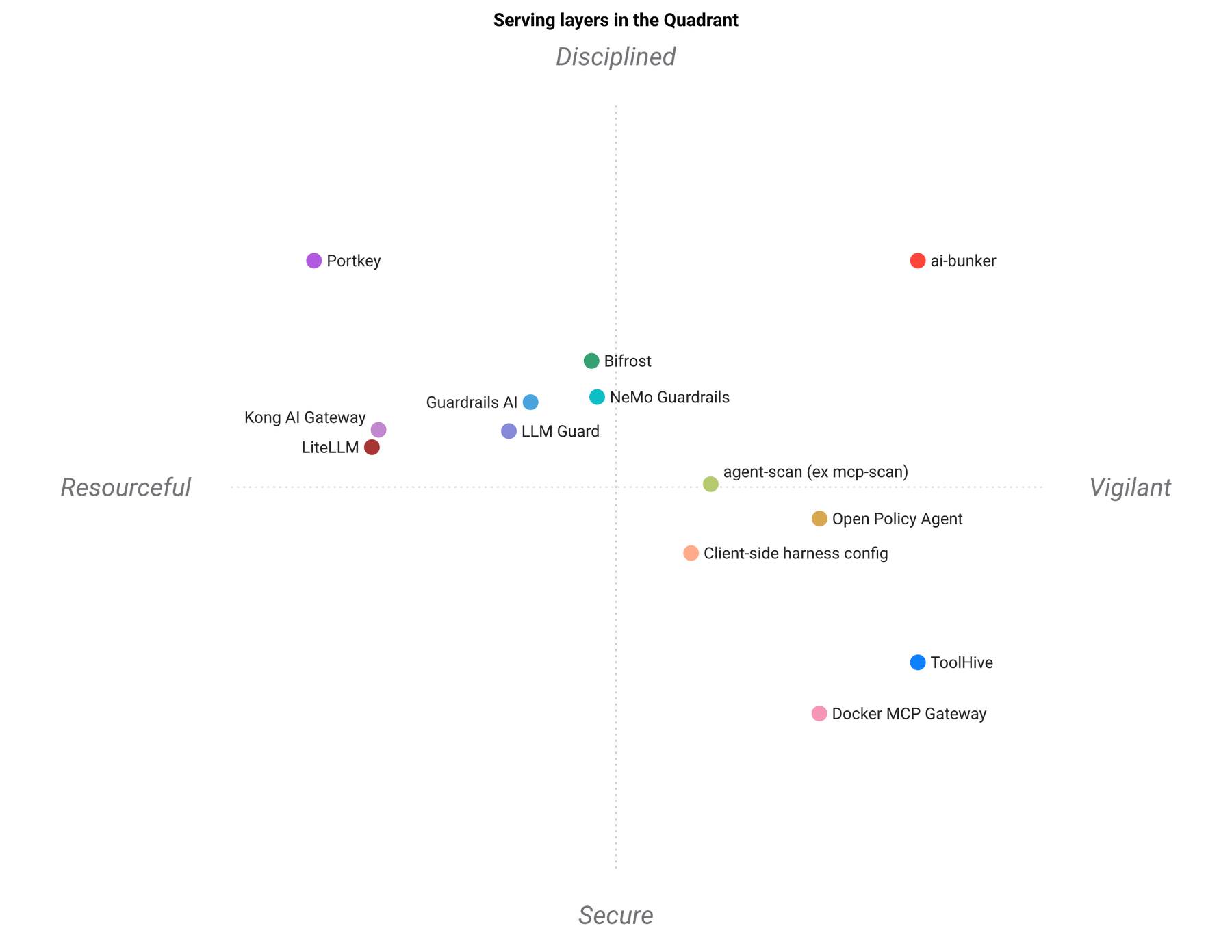
Three clusters, and an empty corner
Left — the gateways
LiteLLM, Kong, Portkey. One OpenAI-shaped surface over a hundred providers, with keys, budgets, retries and observability — done very well. What they do not do is look at what the agent is reading or about to run: a tool result full of secrets and a rm -rf ~ pass through as ordinary bytes.
Right and below — the rule engines
NeMo Guardrails, Guardrails AI, LLM Guard. They inspect content properly, and several do it better than this project. What they are not is a gateway: they are libraries you call, so an agent that does not call them is unprotected, and swapping harness loses them entirely.
Top right — empty except this
Nobody else combines the gateway's position — every request, every client, no opt-out — with the rule engine's inspection and a budget the server counts. That is a claim about coverage, not about quality.
Where this project is behind
Worth stating, since a landscape where one tool wins every column is a landscape nobody believes.
- Provider breadth — LiteLLM, by a wide margin
- A hundred providers against whatever you configure here. If the question is "call many providers through one client", LiteLLM is simply the answer — and ai-bunker can sit in front of it rather than compete.
- Content classifiers — LLM Guard and Guardrails AI
- Their scanners are trained models and curated validator hubs; this ships versioned regular expressions with an entropy gate. Reviewable, diffable and free to run — a deliberate trade, and on raw detection quality it is a trade, not a win.
- Policy expressiveness and testing — OPA
- Rego expresses conditions a regex cannot, and OPA's test tooling with coverage is better than rules --check. The idea of policy carrying its own tests was taken from there.
- Maturity
- This is 0.2.0-alpha next to projects with years of production use.
Ideas taken from the field
None of this was invented here, and saying so costs nothing.
-
Open Policy Agent
Policy carries its own tests, and decisions are logged from day one. Both are now load-bearing here — and the first caught three wrong patterns before they reached a deployment.
-
gitleaks
Regex and an entropy gate, plus per-rule allowlists. A scanner that cries wolf teaches its readers to ignore it.
-
Microsoft's spotlighting
Mark retrieved content as data. Pattern matching catches clumsy injection attempts; the structural marking is what holds when the patterns miss.
-
Agent-harness research
The "prevention versus cure" split: bound context structurally, or let it grow and compress. This project is prevention, moved server-side — which the taxonomy does not have a box for.