Favorite AI resources

In the field of artificial intelligence, which evolves at a breakneck pace, it is common to see a high volume and rate of publications, both scientific and non-scientific. This can feel intimidating and I'm often asked how to find one's way through it.

It is in that context that I offer a list of works I find particularly remarkable, along with a few comments, for readers eager to set out on the fascinating adventure of AI.

44 resources

Cover of AI explainer videos
🎥 Video 2025 🇬🇧

Julia Turc

Machine Learning / Data Science / Deep Learning Natural Language Processing Programming

AI explainer videos

Learning 💪
This YouTube channel offers clear, technically serious explainers on modern AI: diffusion and flow matching, quantization, reinforcement learning for LLMs (large language models), reasoning models and the engineering details that often disappear behind product demos. Julia Turc brings the perspective of a former Google Research engineer and startup founder, connecting papers, intuition and practical constraints without turning the subject into hype.

Loving 💜
I like the tone: precise, energetic and slightly skeptical in a very healthy way. The videos have the rare quality of making fashionable topics feel intellectually tractable again. They are especially useful when you want to understand why an idea works, where its limits are and what engineering trade-offs are hiding behind the impressive demos.

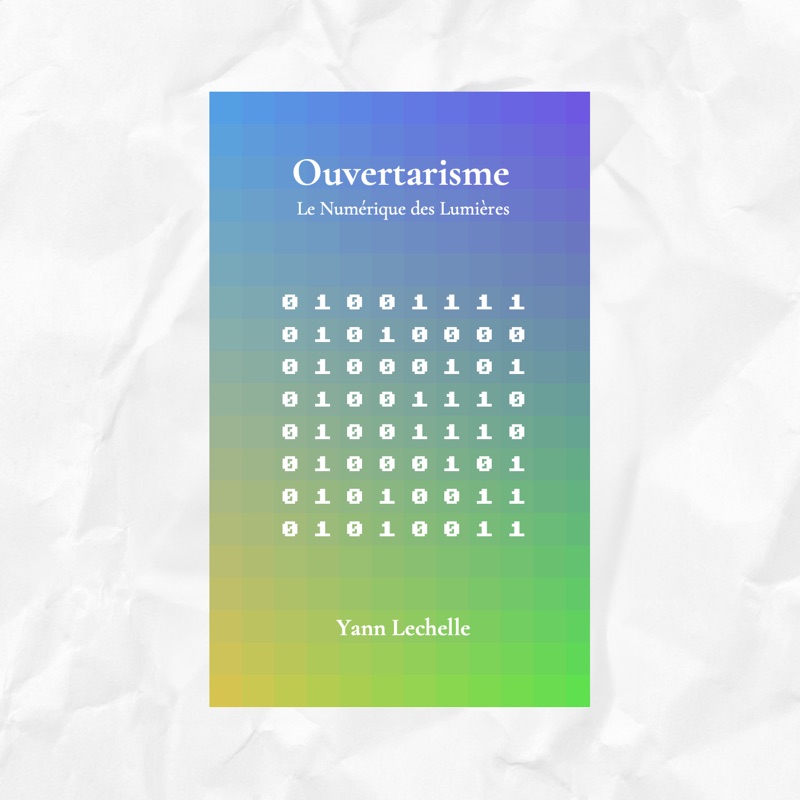
Cover of Ouvertarisme
📚 Book 2024 🇫🇷

Yann Lechelle

Philosophy & History of Technology

Ouvertarisme

Learning 💪
In this manifesto, Yann Lechelle does more than reclaim "Open Source" from marketing slogans and moral posturing. He proposes a tougher idea: Ouvertarisme, the ethic of deliberate openness. Open source, open data and open weights are not ideological options here. They are the economic and technical infrastructure needed to build digital systems that are robust, sovereign and built to last.
Lechelle refuses the usual confusion: not everything deserves to be open in the same way or for the same reasons. He weaves together the commons, the company and the public interest without naivety, insisting that a satisfied user is as much a human driver as an economic one. Now that AI and software have become major levers of power, this argument reaches well past economics into geopolitics, citizenship and how we relate to intelligence itself.

Loving 💜
I had the chance to work alongside Yann Lechelle at probabl.ai, the company behind scikit-learn, the tool that shaped my career as a data scientist, and this book struck a chord. What I like most is that it steps past the tired standoff between naive idealism and market cynicism. Ouvertarisme assumes the best tools are born when intellectual rigor, real-world usefulness and the commons reinforce one another. It reminds us, rightly, that open source is neither a romantic posture nor a political alibi: it is the quiet, demanding engine behind the tools the whole world runs on. A rare, mature and useful argument.

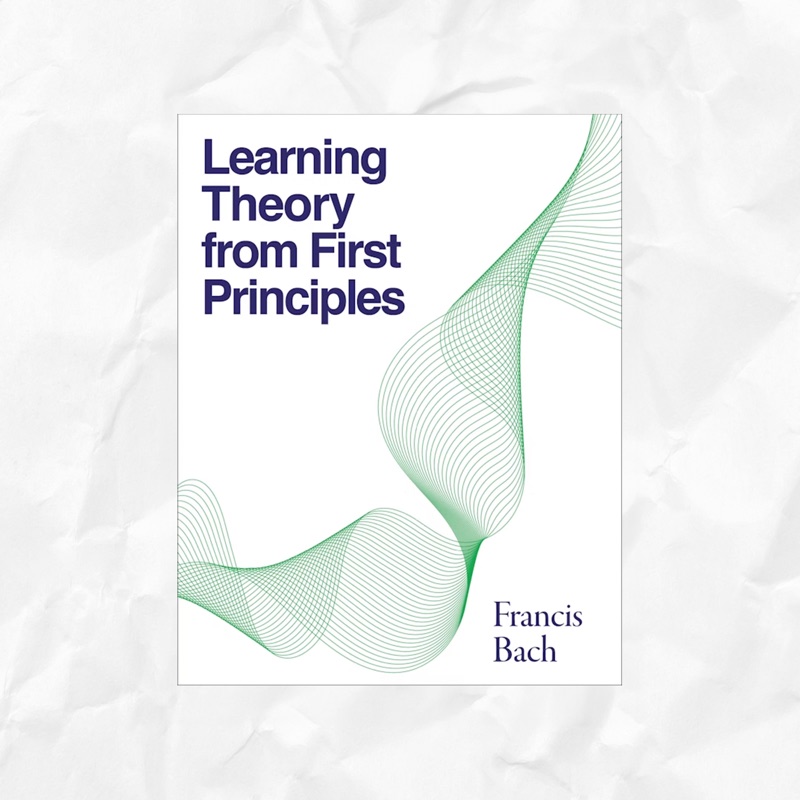
Cover of Learning Theory from First Principles
📚 Book 2024 🇬🇧

Francis Bach

Machine Learning / Data Science / Deep Learning

Learning Theory from First Principles

Learning 💪
This book is a rare attempt to rebuild machine learning theory from the ground up, starting not from fashionable models but from the fundamental questions: what does it mean to learn, under which assumptions and at what cost in data, computation and structure. Francis Bach develops a coherent theory of supervised learning rooted in decision theory, concentration inequalities, optimization and approximation, carefully exposing the trade-offs that govern generalization.
Rather than organizing the field by model families, the book progresses by principles. Classical methods such as linear regression, kernel methods, sparsity and nearest neighbors are treated as canonical case studies through which core ideas emerge: regularization as necessity, assumptions as the true source of learning and rates as the only honest currency. Neural networks, ensembles and overparameterized models are analyzed in deliberately simplified settings where estimation, optimization and implicit bias can be understood precisely: this dispels the myth that parameter count alone explains generalization.
The treatment is unusually unified: convex and non-convex optimization, stochastic gradient descent, variance reduction, online learning, bandits, structured prediction, probabilistic interpretations, PAC-Bayesian analysis and matching lower bounds are all connected through a consistent mathematical language.

Loving 💜
What I admire most is the intellectual honesty of this book, encouraging me to ask fundamental questions that sharpen both understanding and hands-on intuition. There is no hand-waving, no slogan-level intuition and no reverence for models just because they are popular. Every method earns its place through assumptions, proofs and rates. What is rare is that this rigor targets exactly the topics that most theory books still treat as footnotes: overparameterization, implicit bias, modern optimization dynamics. It reshaped how I think about generalization, especially in modern settings where these effects matter more than textbook capacity measures.
This is a book to grow with. For anyone who wants to move beyond recipes and understand why learning algorithms actually work, or provably cannot, this is one of the most demanding and rewarding references available today.

Cover of :probabl.
🎥 Video 2024 🇬🇧

Vincent D. Warmerdam

Machine Learning / Data Science / Deep Learning Enterprise AI

:probabl.

Learning 💪
This is the community classroom of Probabl, the open-source team behind scikit-learn. The channel mixes whiteboard explainers, live-coding sessions and "paper seasons" that unpack topics like histogram-based gradient boosting and RAG-style document search. Each episode shows how to diagnose data issues, pick the right estimator and reason probabilistically so your tabular ML stays efficient and honest.

Loving 💜
Vincent's style blends dry humor with empirical rigor. His friendly cynicism slices through hype, turning hidden gotchas into "aha" moments, and his doodles make Bayes and bootstraps feel intuitive. Knowing that the packages and habits he demonstrates on screen are the same ones he ships and maintains in open source changes how I watch these videos: this isn't someone narrating scikit-learn from the outside, it's someone showing you the actual internals of tools millions of people already depend on. Watching feels like pair-programming with a seasoned open-source maintainer. You leave every video armed with practical wisdom and a healthier dose of doubt.

Cover of Algonaute – Une sélection personnelle d'ouvrages techniques (ou presque)
🌐 Website 2024 🇫🇷

Antoine Gerbaud, Thomas Gerbaud

Philosophy & History of Technology

Algonaute – Une sélection personnelle d'ouvrages techniques (ou presque)

Learning 💪
Algonaute is a JavaScript-free corner of the French-speaking web where two data-scientist brothers keep a living library on AI, computer science and cognitive science. Every entry places the book in its historical and technical context, points out its strengths as well as its limits, and is not afraid to say when a 1,700-page brick becomes "fairly unreadable."

Loving 💜
A quote from Montaigne opens the page, roughly: "one must travel to rub and sharpen one's mind against that of others," a fitting reminder that reading is itself an intellectual journey. I love the humanist tone: free, funny, sometimes lyrical, always rigorous. You come away with a list of honest recommendations, a critical distance on AI's promises and a renewed appetite for your own curiosity.

Cover of The Regularization Cookbook
📚 Book 2023 🇬🇧

Vincent Vandenbussche

Machine Learning / Data Science / Deep Learning

The Regularization Cookbook

Learning 💪
Regularization is the set of ideas that prevents machine learning models from memorizing data instead of learning from it. This book is a practical guide to recognizing when a model is too complex, too confident or too fragile, and to fixing it using simple, well-tested techniques.
Rather than starting from abstract theory, the cookbook approach focuses on concrete situations: models that overfit, predictions that fail to generalize or training procedures that look good on paper but behave poorly in practice. Each chapter explains why a model misbehaves, what kind of regularization helps and how to apply it, with runnable Python examples throughout.
The book covers regularization across a wide range of models, from linear regression and decision trees to neural networks, showing how ideas like simplifying models, constraining parameters, injecting noise or stopping training at the right time all serve the same underlying goal: improving robustness to new data.

Loving 💜
What makes this book stand out is its pragmatic mindset. It does not treat regularization as a theoretical afterthought, but as a core modeling skill, on par with choosing the right features or evaluation metric. I particularly appreciate how it bridges classical machine learning and modern deep learning without artificial boundaries.
This is the kind of book you keep nearby while working: not to read cover to cover, but to reach for when a model "almost works" and you need to understand how to make it reliable. Clear, honest and grounded in real practice.

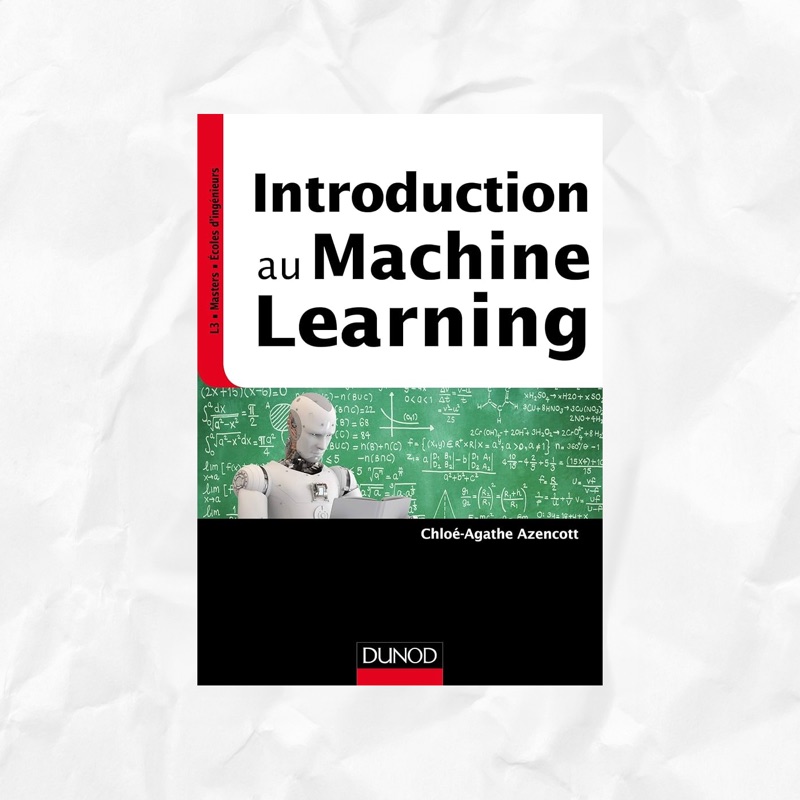
Cover of Introduction au Machine Learning
📚 Book 2022 🇫🇷

Chloé-Agathe Azencott

Machine Learning / Data Science / Deep Learning

Introduction au Machine Learning

Learning 💪
This course material offers a rigorous, step-by-step introduction to machine learning, from the underlying statistics to the models used daily in practice: regression, decision trees, kernel methods, neural networks and cross-validation. The concepts come with just enough math to understand what you are actually doing, without ever losing sight of real data and real use cases.
It is especially well suited to graduate students in mathematics or statistics who are asking themselves how to turn a theoretical degree into an actual job. It shows how the classical mathematical toolkit (probability, optimization, linear algebra) extends naturally into today's data science and machine learning practice.

Loving 💜
What I appreciate most is the teaching clarity and the honest positioning: neither shallow popularization nor an abstract treatise. It is an excellent bridge between the academic world and the workplace, for anyone who wants to understand what they are doing and why before deploying models in a company.
A reassuring, well-structured book for scientific minds who want direction without giving up intellectual rigor.

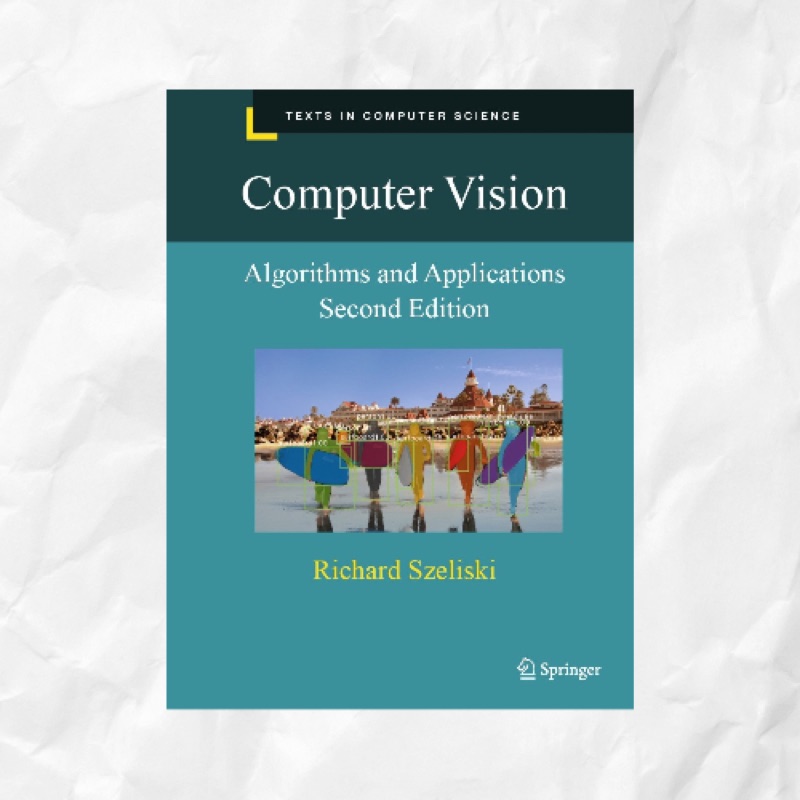
Cover of Computer Vision: Algorithms and Applications, 2nd Edition
📚 Book 2022 🇬🇧

Richard Szeliski

Computer Vision

Computer Vision: Algorithms and Applications, 2nd Edition

Learning 💪
This book offers a remarkably clear and comprehensive introduction to computer vision, covering the full pipeline from low-level image processing to high-level scene understanding. Topics such as filtering, feature extraction and matching, geometry, motion, 3D reconstruction and computational photography are presented with a rare balance of depth and accessibility.
What sets this book apart is its exceptional use of illustrations. Nearly every concept is accompanied by carefully designed figures that make abstract ideas immediately tangible. The visual explanations are not decorative: they are integral to the reasoning, helping the reader build intuition about geometry, uncertainty and representation in images.

Loving 💜
Reading this book constantly reminds me why I am so attached to the "computer vision school of AI." The field's way of thinking, grounded in geometry, physics and explicit models of the world, comes through on every page. The richness of the illustrations makes the algorithms feel concrete, almost physical, and turns learning into a genuinely visual experience.
What I value beyond the teaching is that it doubles as a living map of the research literature itself: I have used it as often to find my bearings in a new subfield as to relearn a fundamental technique. This is a book that teaches you not only how computer vision algorithms work, but how to think visually. A rare and satisfying reference.

Cover of Introduction to Algorithms
📚 Book 2022 🇬🇧

Thomas H. Cormen, Charles E. Leiserson, Ronald L. Rivest, Clifford Stein

Algorithms and Optimization

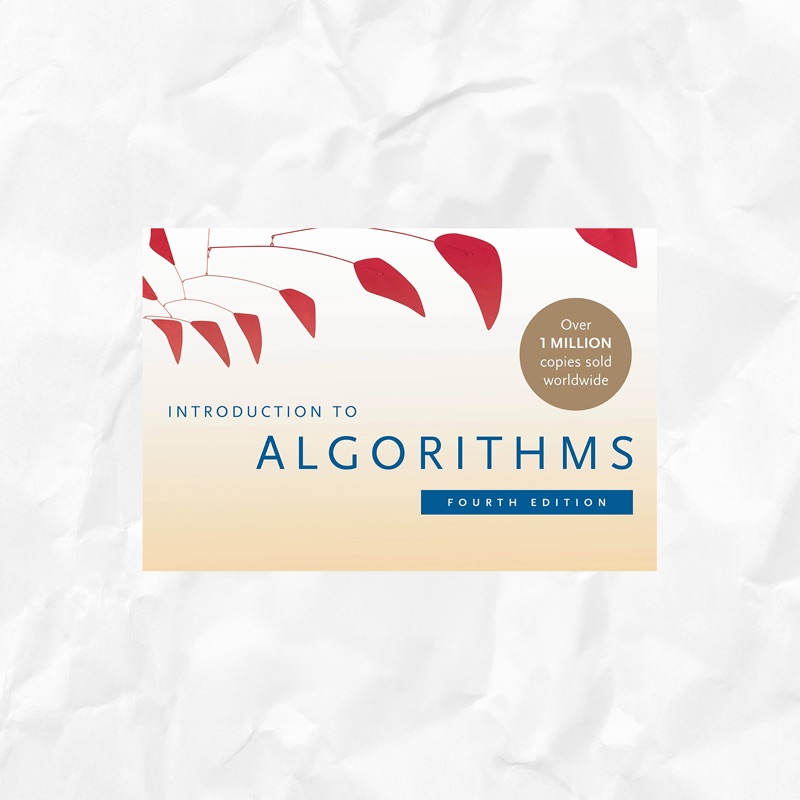
Introduction to Algorithms

Learning 💪
Despite its modest title, this book is anything but an introduction in the casual sense. It offers a deep, systematic and rigorous treatment of algorithms, covering a vast range of topics, from sorting, dynamic programming and graph algorithms to advanced data structures, amortized analysis and randomized methods.
The strength of this book lies in its precision. Algorithms are not presented as clever tricks, but as carefully analyzed objects, with explicit assumptions, correctness proofs and complexity guarantees.

Loving 💜
I like to joke about the word "introduction" in the title: someone who masters this book is unquestionably knowledgeable about algorithms. It has become so central to the field that people just call it by its authors' initials, the way you would refer to a law rather than a book. Working through it trains a particular way of thinking: breaking problems down, reasoning about limits and designing solutions that scale.
This is not a book you simply read; it is a book you wrestle with. And if you emerge on the other side, you carry with you a lasting algorithmic mindset that pays dividends across computer science, data science and AI.

Cover of Model-Based Clustering and Classification for Data Science
📚 Book 2021 🇬🇧

Charles Bouveyron, Gilles Celeux, T. Brendan Murphy, Adrian E. Raftery

Machine Learning / Data Science / Deep Learning

Model-Based Clustering and Classification for Data Science

Learning 💪
This book presents model-based clustering and classification as a coherent statistical framework rather than a collection of algorithms. Instead of asking “which clustering method should I apply?”, it starts from a more fundamental question: what assumptions am I making about the data-generating process?
Through mixture models and latent-variable formulations, the authors show how clustering, classification and dimensionality reduction naturally emerge from explicit probabilistic models. Gaussian mixtures, subspace models and high-dimensional extensions are treated not as black boxes, but as design choices, each with clear implications for interpretability, uncertainty and generalization.
A key strength of the book is its ability to bridge theory and practice without shortcuts. Identifiability, model selection, regularization and estimation are discussed alongside practical algorithms such as EM (Expectation-Maximization), with careful attention to high-dimensional settings where naive methods fail.

Loving 💜
What I particularly appreciate is how this book teaches you to design models instead of blindly applying algorithms. It cultivates a mindset where clustering is an act of modeling assumptions, not an exploratory afterthought. This makes it intellectually satisfying and immediately useful in real projects, especially when interpretability and robustness matter. I also like that it comes from authors who built much of this subfield's core machinery themselves, which shows in how naturally the model-selection criteria and identifiability caveats are woven into the narrative rather than tacked on as disclaimers.
For anyone who wants to move beyond heuristic clustering and understand unsupervised learning as a statistical science, this book is an outstanding and quietly demanding reference.

Cover of Computational Optimal Transport
📚 Book 2020 🇬🇧

Gabriel Peyré, Marco Cuturi

Algorithms and Optimization

Computational Optimal Transport

Learning 💪
This 209-page book explores optimal transport through a computational lens, from historical roots to cutting-edge methods like entropic regularization. It covers applications across imaging, graphics and machine learning, with tools like the Python Optimal Transport (POT) toolbox, developed by Rémi Flamary and Nicolas Courty.

Loving 💜
I love its balance of theory, algorithms and real-world relevance. It arrived exactly when optimal transport was shifting from a beautiful but computationally forbidding theory into something you could actually run at scale, thanks to entropic regularization, and the book captures that turning point better than any paper survey I know. The clarity, the precision and the richness of the companion resources make it unique: it is the only book I know that treats optimal transport with such computational finesse.

Cover of Artificial Intelligence: A Modern Approach, 4th Edition
📚 Book 2020 🇬🇧

Stuart Russell, Peter Norvig

Machine Learning / Data Science / Deep Learning

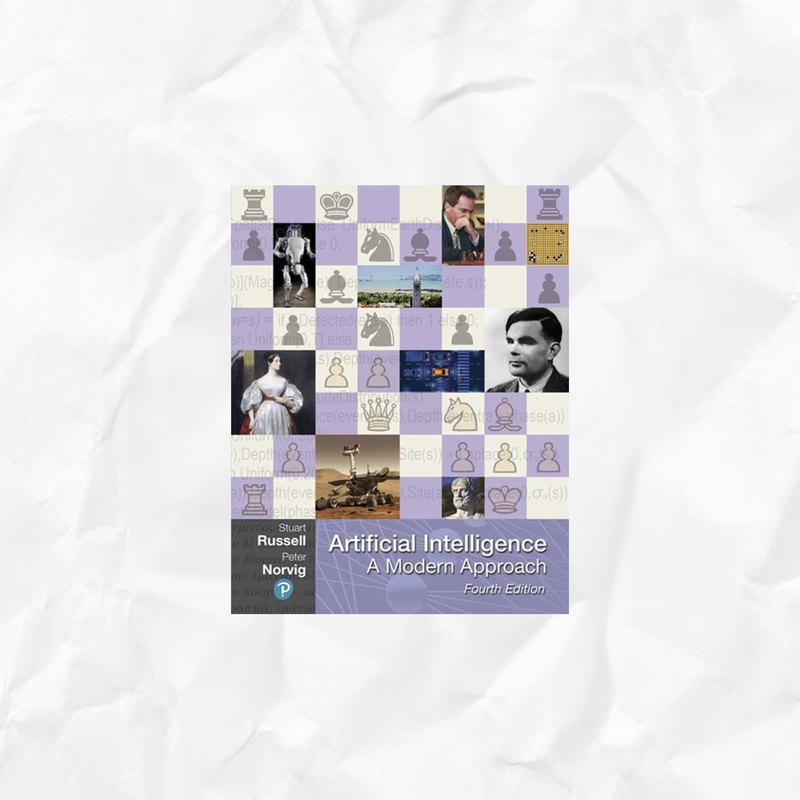
Artificial Intelligence: A Modern Approach, 4th Edition

Learning 💪
The reference map of the whole field: search, logic, probabilistic reasoning, planning, learning and agents, all tied together by the single idea of a rational agent acting under uncertainty.

Loving 💜
It is the book I keep coming back to when I need the rigorous, unifying view behind a technique I use every day. What I find remarkable is how it has stayed the default starting point across generations of AI curricula worldwide, through symbolic AI winters and multiple deep learning waves, simply by keeping the rational-agent framing broad enough to absorb whatever the field reinvents next. It is the one textbook every serious AI education still starts from.

Cover of Human Compatible: Artificial Intelligence and the Problem of Control
📚 Book 2019 🇬🇧

Stuart Russell

Philosophy & History of Technology Enterprise AI

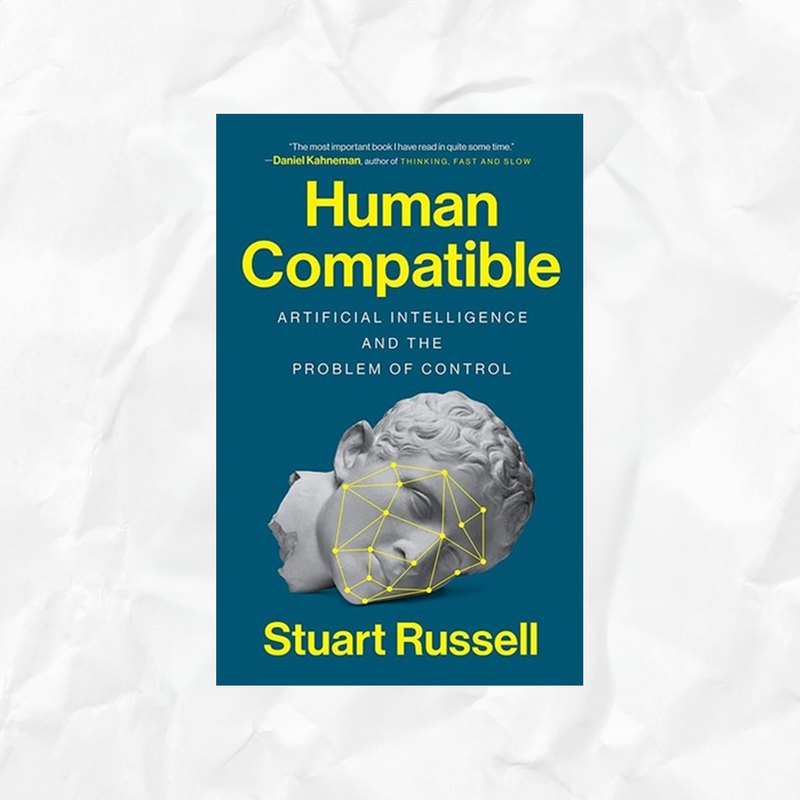
Human Compatible: Artificial Intelligence and the Problem of Control

Learning 💪
A rewrite of the very definition of AI: instead of optimizing a fixed objective, a well-designed system should stay uncertain about what we actually want and keep deferring to us.

Loving 💜
Coming from one of the authors of my other favorite reference above (AIMA, Artificial Intelligence: A Modern Approach), it turns a research agenda into a genuinely usable governance principle for anyone deploying AI in production. What convinces me is that the proposal is refreshingly concrete for a book about AI risk: instead of just warning about misaligned objectives, it redesigns the objective itself. A system that stays deliberately uncertain about what we want is a design pattern I can actually explain to an engineering team, not just a philosophical stance.

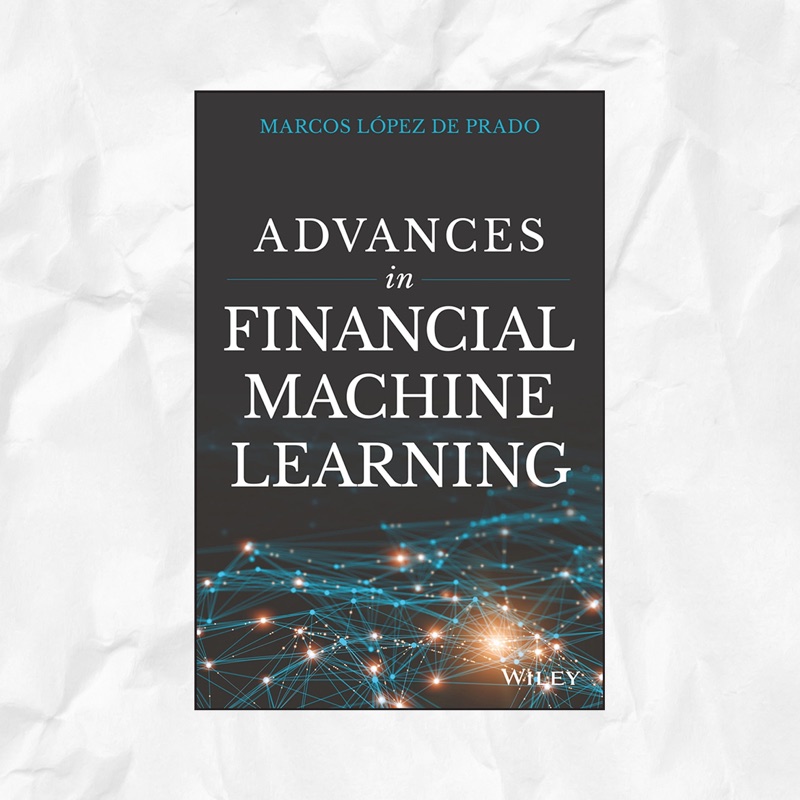
Cover of Advances in Financial Machine Learning
📚 Book 2018 🇬🇧

Marcos Lopez de Prado

Signal Processing and Information Theory

Advances in Financial Machine Learning

Learning 💪
This book tackles a domain where mistakes are immediately costly: financial markets. Rather than presenting machine learning as a source of magical alpha, it focuses on the hard problems that arise when working with time series, noisy signals, feedback loops and limited data. The emphasis is on experimental rigor: proper backtesting, data leakage prevention, realistic validation schemes and metrics that actually reflect decision quality.
Marcos López de Prado reframes machine learning as a statistical and signal-processing discipline applied under severe constraints. Many of the ideas, especially around evaluation and dependence in data, extend far beyond finance and apply directly to any real-world sequential or temporal setting.

Loving 💜
What I value most in this book is its intellectual discipline. It relentlessly exposes how easy it is to fool yourself with apparently strong results when the experimental setup is flawed. I think it is often misread as a cookbook of trading recipes, when its real subject is closer to epistemology: how not to fool yourself when applying machine learning to noisy, non-stationary data. Even if you never plan to work in finance, the mindset it enforces, skepticism, careful validation and respect for the data-generating process, is invaluable.
This is a book about learning under adversarial conditions: non-stationarity, feedback and delayed rewards. In that sense, it is less about finance than about what it actually takes to build machine learning systems that survive contact with reality, especially with time series.

Cover of Reinforcement Learning, 2nd Edition
📚 Book 2018 🇬🇧

Richard S. Sutton, Andrew G. Barto

Reinforcement Learning

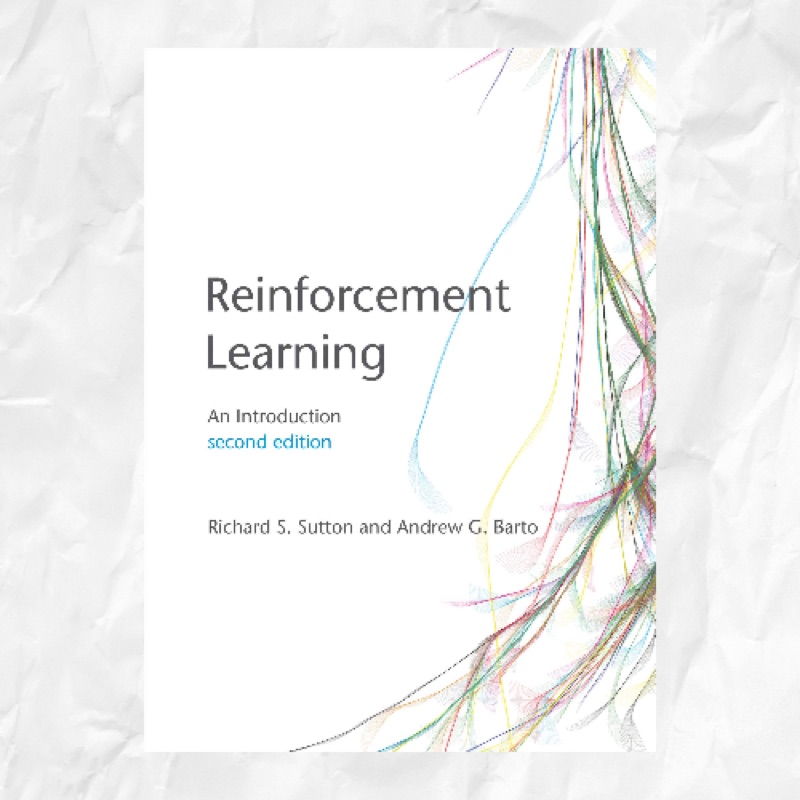
Reinforcement Learning, 2nd Edition

Learning 💪
According to many, this book is the definitive introduction to reinforcement learning, written by the pioneers of the field. It presents learning as a problem of sequential decision-making under uncertainty, where an agent must balance exploration and exploitation while interacting with an environment over time.
Starting from first principles, Sutton and Barto introduce Markov Decision Processes, value functions, policies and dynamic programming before moving to Monte Carlo methods, temporal-difference learning and modern extensions involving function approximation and deep learning.
What makes the book especially valuable is its conceptual clarity. Reinforcement learning is not framed as a collection of tricks for games or robotics, but as a unifying framework connecting control theory, optimization, psychology and machine learning.

Loving 💜
I appreciate the pedagogical honesty of this book. It takes the time to build intuition, to explain why things are hard and to show where assumptions enter the picture. There is no hype, just carefully constructed ideas that have stood the test of time, written by the very people who spent their careers building the field from nothing. That is why it reads less like a survey and more like a personal account of how the ideas actually emerged.
This is the kind of book that gives you a durable mental model of reinforcement learning. Even if you never train a deep RL agent, it permanently changes how you think about decision-making, feedback and learning over time.

Cover of La plus belle histoire de l'intelligence : Des origines aux neurones artificiels
📚 Book 2018 🇫🇷

Stanislas Dehaene, Yann LeCun, Jacques Girardon

Philosophy & History of Technology

La plus belle histoire de l'intelligence : Des origines aux neurones artificiels

Learning 💪
In this lively dialogue, a neuroscientist and a deep learning pioneer trace the thread of intelligence from the first chipped stones to today's AI chips. Along the way, they reconnect biology, the history of ideas and modern algorithms: Darwin meets Turing, the hippocampus crosses paths with the perceptron, and it all clicks into place.

Loving 💜
This is one of the rare books that can hold my attention as well as it holds my 86-year-old father's: accessible without being simplistic, full of vivid analogies, it gently proves that science is a human adventure. What I particularly like about the dialogue format is that it forces both authors out of their respective jargon and into a real confrontation of intuitions. Neuroscience and deep learning actually answer each other here, instead of politely coexisting. A perfect way to pass on a love of AI to a general audience, and a good reminder of why research work matters.

Cover of Kaggle Learn
💻 Code 2017 🇬🇧

Alexis Cook, Kaggle

Machine Learning / Data Science / Deep Learning Programming

Kaggle Learn

Learning 💪
This is a hands-on, beginner-friendly platform for learning Python and data science fundamentals through short, interactive lessons and real datasets. It is a practical launchpad for anyone entering the field.

Loving 💜
I love how self-paced and digestible it is. What I find genuinely well designed is the format itself: each micro-course is short enough to finish in one sitting, which respects a beginner's attention span far better than the sprawling multi-week courses everyone defaults to. Whether you are starting from scratch or revisiting key concepts, Kaggle Learn makes it easy to learn by doing, without getting lost in theory.

Cover of Yannic Kilcher
🎥 Video 2017 🇬🇧

Yannic Kilcher

Machine Learning / Data Science / Deep Learning

Yannic Kilcher

Learning 💪
This YouTube channel breaks down the latest research papers and concepts in AI, especially deep learning, in a way that is digestible, thorough and surprisingly entertaining.

Loving 💜
Yannic is like that sharp friend who reads all the new papers so you do not have to. What sets him apart from most paper-summary content is that he does not just narrate the abstract: he pushes back on weak experiments and inflated claims, which is the actual skill of reading papers critically, not just reading them fast. His clarity saved me hours (attention mechanisms, anyone?) and helped me decide what to explore further. It is my go-to shortcut for staying current in the field.

Cover of Neural Network Methods in Natural Language Processing
📚 Book 2017 🇬🇧

Yoav Goldberg

Natural Language Processing

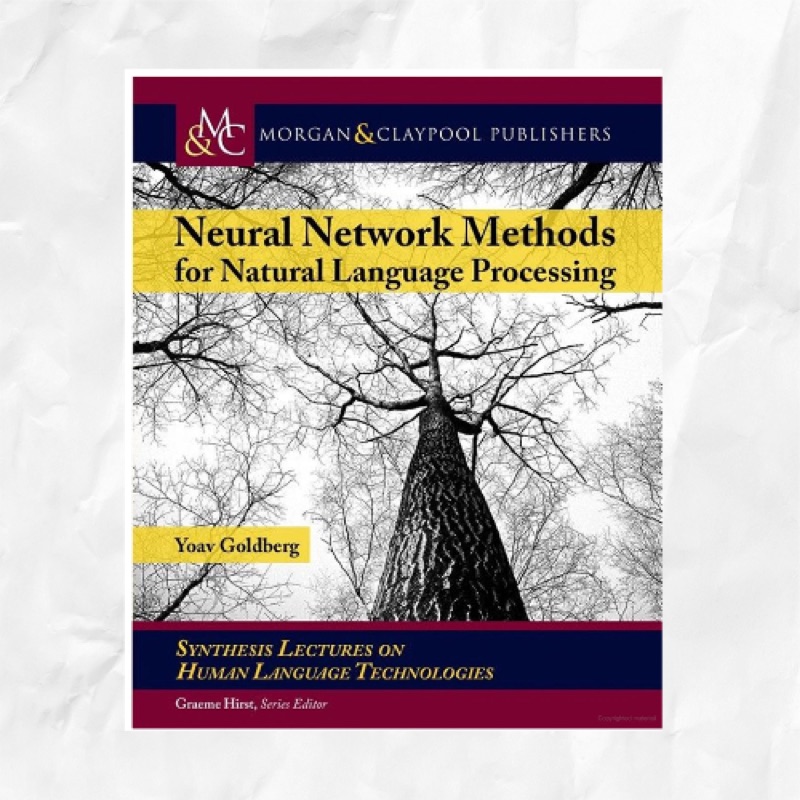
Neural Network Methods in Natural Language Processing

Learning 💪
This practical and well-explained guide introduces modern NLP through neural networks and embeddings, connecting theory with the deep learning techniques that revolutionized the field in the 2010s, starting with word2vec.

Loving 💜
It was one of the first texts that made NLP click for me. Yoav Goldberg's clarity, especially around tricky concepts like representation and embeddings, makes this a go-to resource for grasping both intuition and implementation. What I appreciate on rereading it is how compact it stays while never feeling superficial: it earns its place next to much longer references by being ruthless about which ideas actually matter.

Cover of fast.ai
💻 Code 2017 🇬🇧

Jeremy Howard, Sylvain Gugger

Machine Learning / Data Science / Deep Learning Programming

fast.ai

Learning 💪
fast.ai offers free, practical deep learning courses that aim to democratize AI. The courses start with hands-on coding (using PyTorch and the fastai library) before diving into theoretical foundations, reversing the traditional top-down approach to AI education.

Loving 💜
I love how fast.ai empowers learners from all backgrounds. What I find most convincing is the pedagogical bet itself: start by training a working model in the first lesson and only unpack the theory once the student already has a working intuition for what needs explaining. That is the reverse of how I was taught, and honestly the more effective order for most people. The focus on code-first, ethics-aware and accessible AI education makes it not just a learning platform but a movement.

Cover of Deep Learning
📚 Book 2016 🇬🇧

Ian Goodfellow, Yoshua Bengio, Aaron Courville

Machine Learning / Data Science / Deep Learning

Deep Learning

Learning 💪
This book offers both an accessible introduction and a solid deep dive into deep learning techniques, covering neural networks, optimization and unsupervised learning. It builds from foundational math, like linear algebra and calculus, making it a great fit for anyone ready to code and explore further.

Loving 💜
I like how it bridges theory and practice without being overly advanced. What strikes me, looking back, is that it remains the only genuinely comprehensive account of the field written before deep learning fractured into a hundred specialized subfields. That is exactly why it still works as the shared vocabulary everyone in the room can fall back on, whatever their specialty became afterward. It is approachable yet rigorous, and it has become a classic reference for anyone wanting to understand the core mechanics of deep learning models.

Cover of Two Minute Papers
🎥 Video 2016 🇬🇧

Károly Zsolnai-Fehér

Machine Learning / Data Science / Deep Learning Computer Vision

Two Minute Papers

Learning 💪
This YouTube channel distills cutting-edge research papers, across computer graphics, simulation, computer vision and AI, into short, accessible videos. Károly Zsolnai-Fehér highlights the core idea, the visual results and the leap each paper makes compared to prior work, with a clear sense of scientific progress.

Loving 💜
What I love is the contagious enthusiasm ("What a time to be alive!") paired with genuine intellectual honesty about limitations and follow-up work. Over a thousand episodes and a decade later, what impresses me most is the consistency: the format never drifted into hype or clickbait even as the field around it became one of the most hyped in history. It is a great way to keep a wide peripheral view on fields adjacent to one's own and to remember that research is a long, cumulative journey rather than a sequence of isolated breakthroughs.

Cover of Superintelligence: Paths, Dangers, Strategies
📚 Book 2014 🇬🇧

Nick Bostrom

Philosophy & History of Technology Enterprise AI

Superintelligence: Paths, Dangers, Strategies

Learning 💪
A systematic map of how advanced AI systems could gain and misuse autonomy: orthogonality, instrumental convergence, the control problem, argued with the rigor of a proof, not a manifesto.

Loving 💜
It gave me the vocabulary I still use every time I talk about autonomy, guardrails and the cost of an error in an agentic system, years before "agentic AI" became a buzzword. What I respect most is that it treats the argument with the discipline of a proof rather than the urgency of a manifesto: orthogonality and instrumental convergence are argued step by step. That discipline is exactly why the book outlived the news cycle that briefly made it fashionable and became required reading for an entire discipline instead.

Cover of Matrix Computations, 4th Edition
📚 Book 2013 🇬🇧

Gene H. Golub, Charles F. Van Loan

Algorithms and Optimization Programming

Matrix Computations, 4th Edition

Learning 💪
This book is a definitive reference on numerical linear algebra, covering matrix factorizations, eigenvalue problems, iterative methods and large-scale computations with exceptional depth and clarity. It explains not only how algorithms work, but why they are structured the way they are, with constant attention to numerical stability and computational efficiency.
What makes this book especially important is that it treats linear algebra as a source of algorithms, not just a collection of formulas. Many modern techniques in machine learning, optimization and scientific computing are direct descendants of ideas developed in numerical linear algebra decades ago.

Loving 💜
What I find inspiring is how much creative power still lives in linear algebra. This book constantly reminds me that many of the most elegant algorithms come from carefully reusing and adapting existing mathematical structures, rather than inventing entirely new machinery. I am struck by how, edition after edition, it keeps being cited and rediscovered by people solving problems its authors never imagined, which is the surest sign that its decades of factorizations and stability arguments were never a closed subject.
It would be a real shame to ignore this accumulated knowledge. This book shows that revisiting linear algebra is not about nostalgia: it is about standing on a foundation that continues to generate some of the most robust and beautiful algorithms we have.

Cover of Hugo Larochelle
🎥 Video 2013 🇬🇧

Hugo Larochelle

Machine Learning / Data Science / Deep Learning

Hugo Larochelle

Learning 💪
This YouTube channel offers crystal-clear explanations of advanced machine learning topics, including Restricted Boltzmann Machines and Conditional Random Fields, concepts that are notoriously tricky to grasp.

Loving 💜
Even though the channel has not been active since 2022, the existing videos are timeless. What gives them staying power, I think, is that they come from someone who was doing frontier research on the very models he is explaining, not simply relaying a textbook. The intuition he passes on is the intuition of a practitioner, not a summarizer. Hugo's teaching style is intuitive and focused, making difficult ideas feel accessible without dumbing them down.

Cover of Machine Learning: A Probabilistic Perspective
📚 Book 2012 🇬🇧

Kevin Murphy

Machine Learning / Data Science / Deep Learning

Machine Learning: A Probabilistic Perspective

Learning 💪
These books present machine learning as a unified mathematical discipline grounded in probability theory. Kevin Murphy builds the field from first principles: random variables, graphical models, inference, optimization, showing how a wide range of algorithms emerge naturally from probabilistic modeling choices.
Rather than separating classical statistics and modern machine learning, these books connect linear models, Bayesian inference, graphical models, kernel methods and modern learning algorithms within a single coherent framework.

Loving 💜
This is, in my view, the best machine learning book for people with a strong mathematical background and taste. It rewards comfort with probability, linear algebra and optimization and offers a rare feeling of conceptual unity across the field: the sense that classical statistics and modern learning algorithms were never really two different subjects, just two vocabularies for the same probabilistic reasoning.
If you enjoy understanding models through their probabilistic assumptions and want a reference that remains solid even as algorithms evolve, this book is an exceptional long-term companion.

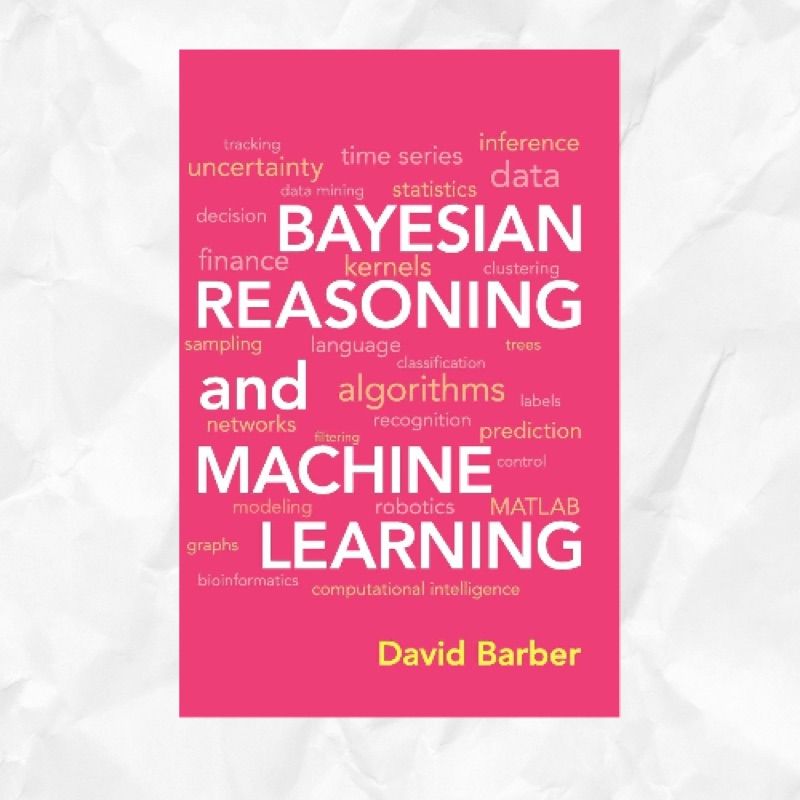
Cover of Bayesian Reasoning and Machine Learning
📚 Book 2012 🇬🇧

David Barber

Machine Learning / Data Science / Deep Learning

Bayesian Reasoning and Machine Learning

Learning 💪
This 735-page book presents the foundations and applications of Bayesian modeling and graphical models, with real-world examples spanning search engines, genomics, finance and robotics. It explains not only how these models work, but what they mean conceptually and practically.

Loving 💜
I love how it demystifies graphical models: those once-confusing circles and arrows now make total sense. Compared to other references covering the same ground, I find it the more forgiving one. It assumes less and still gets you to the same depth, which makes it the book I hand to someone who wants graphical models explained without first requiring a statistics degree. The book builds intuition while staying mathematically solid and bridges the gap between traditional AI and modern ML with elegance and depth.

Cover of Computational Systems Biology of Cancer
📚 Book 2012 🇬🇧

Emmanuel Barillot, Laurence Calzone, Philippe Hupé, Jean-Philippe Vert, Andrei Zinovyev

Healthcare AI Machine Learning / Data Science / Deep Learning

Computational Systems Biology of Cancer

Learning 💪
A comprehensive overview of computational systems biology methods applied to cancer: dynamic modeling of biological networks, high-throughput data mining (microarrays, sequencing) and the translation of clinical questions into mathematical models. It grew out of years of sustained work at the Cancer Systems Biology laboratory of Institut Curie.

Loving 💜
A rare bridge between clinical biology and computational tools, useful to anyone who wants to understand how to turn complex biological data into workable models, well beyond the specific case of cancer.

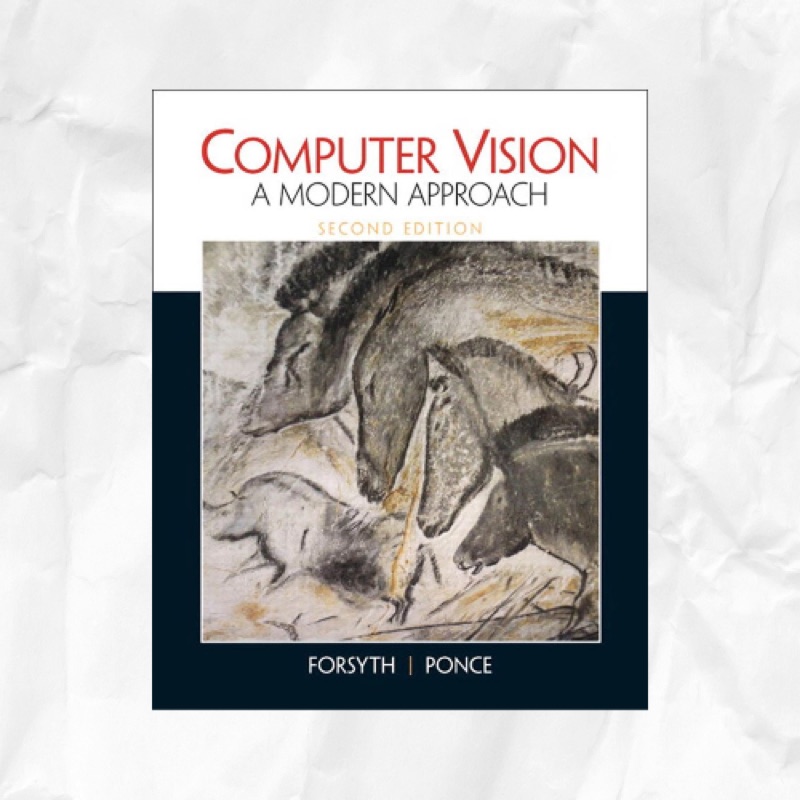
Cover of Computer Vision: A Modern Approach, 2nd Edition
📚 Book 2011 🇬🇧

David Forsyth, Jean Ponce

Computer Vision

Computer Vision: A Modern Approach, 2nd Edition

Learning 💪
This 800-page textbook builds a strong scientific and mathematical foundation for tackling classic computer vision problems, from image modeling and preprocessing to segmentation, feature construction and object recognition.

Loving 💜
I appreciate how it encourages deep understanding rather than surface-level solutions. What sets it apart for me is its breadth: rather than picking one theoretical lens, it lays out the whole enterprise of vision (probabilistic, geometric, statistical) side by side, so you learn to choose the right lens for the problem instead of forcing every problem through the same one. It is rigorous yet inspiring, and its reach extends beyond computer vision, offering insights into computational thinking and perception.

Cover of Don Woodlock
🎥 Video 2010 🇬🇧

Don Woodlock

Enterprise AI Healthcare AI Programming Natural Language Processing

Don Woodlock

Learning 💪
This YouTube channel combines decades of healthcare IT leadership with hands-on demonstrations of applied AI in medicine, from predictive analytics to generative assistants for clinicians.

Loving 💜
The value goes well beyond healthcare. Each video connects real-world constraints (patients, providers, systems) with the actual capabilities and limits of AI. Don Woodlock's dual perspective makes this channel exceptionally credible.

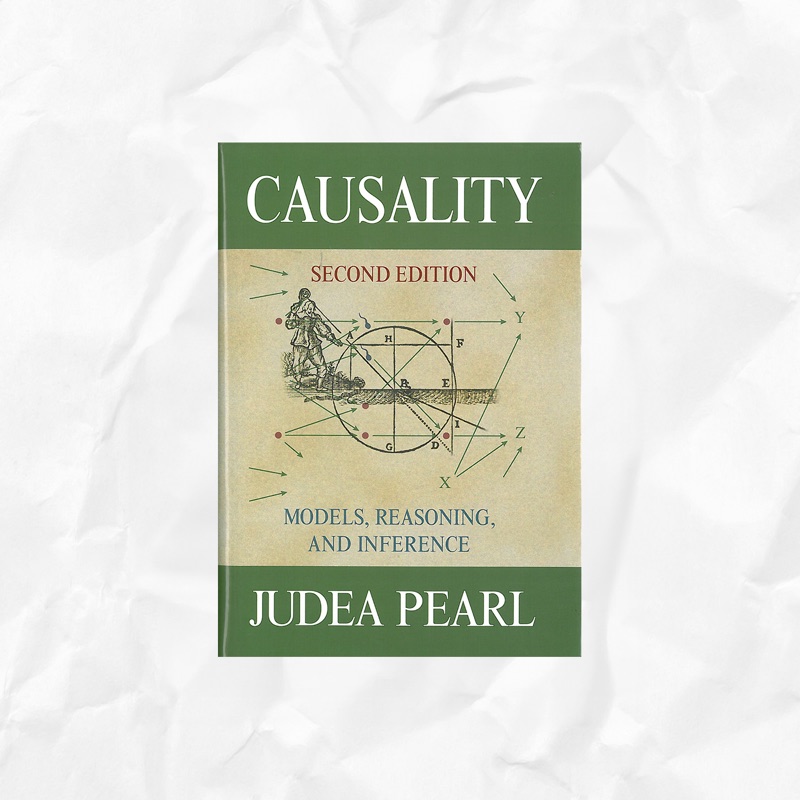
Cover of Causality: Models, Reasoning and Inference, 2nd Edition
📚 Book 2009 🇬🇧

Judea Pearl

Machine Learning / Data Science / Deep Learning

Causality: Models, Reasoning and Inference, 2nd Edition

Learning 💪
Most people, including many AI practitioners, are misled by the distinctions between correlation, dependence and causality. Mastering them is a demanding but intellectually healthy exercise. This seminal 486-page book lays the mathematical and conceptual foundations of causal reasoning. Judea Pearl introduces structural causal models, causal graphs, do-calculus and counterfactual reasoning, drawing a sharp line between prediction and explanation.

Loving 💜
This book reshaped how I think about modeling: frequentist, Bayesian, probabilistic, parametric and non-parametric. What strikes me is that it did not just add a technique to the toolbox. It gave a name, a notation and identification rules to a distinction, correlation versus cause, that entire disciplines had spent decades circling without resolving. Its examples are remarkably effective, whether in research or corporate discussions, because they translate that formal machinery into something anyone can point at on a whiteboard. Whenever debates become fuzzy, I return to them to restore conceptual rigor.

Cover of The Elements of Statistical Learning, 2nd Edition
📚 Book 2009 🇬🇧

Trevor Hastie, Robert Tibshirani, Jerome Friedman

Machine Learning / Data Science / Deep Learning

The Elements of Statistical Learning, 2nd Edition

Learning 💪
This book is a foundational reference for statistical learning theory, covering supervised and unsupervised methods with a strong emphasis on mathematical structure, the bias-variance trade-off and asymptotic behavior. Linear models, splines, trees, ensembles, kernel methods and neural networks are analyzed through a rigorous statistical lens.
What distinguishes this book is not the breadth of methods, but the depth of theoretical insight. Each model is dissected to reveal its assumptions, limitations and failure modes. Even today, many modern discussions in machine learning can be clarified by revisiting the arguments laid out here.

Loving 💜
This is the best machine learning book for people who love theory for its own sake. What I value most is that its authors did not just describe methods they read about: several of them invented the tools in these pages (the lasso, gradient boosting, generalized additive models), so the exposition carries the authority of people who know exactly where each method breaks. I often return to it when something feels unclear or hand-wavy in a project. A single chapter is often enough to restore conceptual precision.
It is demanding, sometimes unforgiving, but immensely rewarding: an indispensable anchor for anyone who wants to reason seriously about learning algorithms.

Cover of A Wavelet Tour of Signal Processing, 3rd Edition
📚 Book 2008 🇬🇧

Stéphane Mallat

Signal Processing and Information Theory

A Wavelet Tour of Signal Processing, 3rd Edition

Learning 💪
This legendary book explores the rich connections between signal processing and algebra, covering wavelets, Fourier transforms, time-frequency analysis, sparsity, compression and more, with clarity and elegance.

Loving 💜
I love its ability to make deep mathematical concepts feel intuitive and useful. What strikes me is that there is really no equivalent: other books cover pieces of this ground, but none combine wavelets, sparsity and time-frequency analysis with the same depth and unity in a single volume. The writing is elegant, the structure thoughtful and the companion resources (especially the Numerical Tours by Gabriel Peyré) are simply excellent.

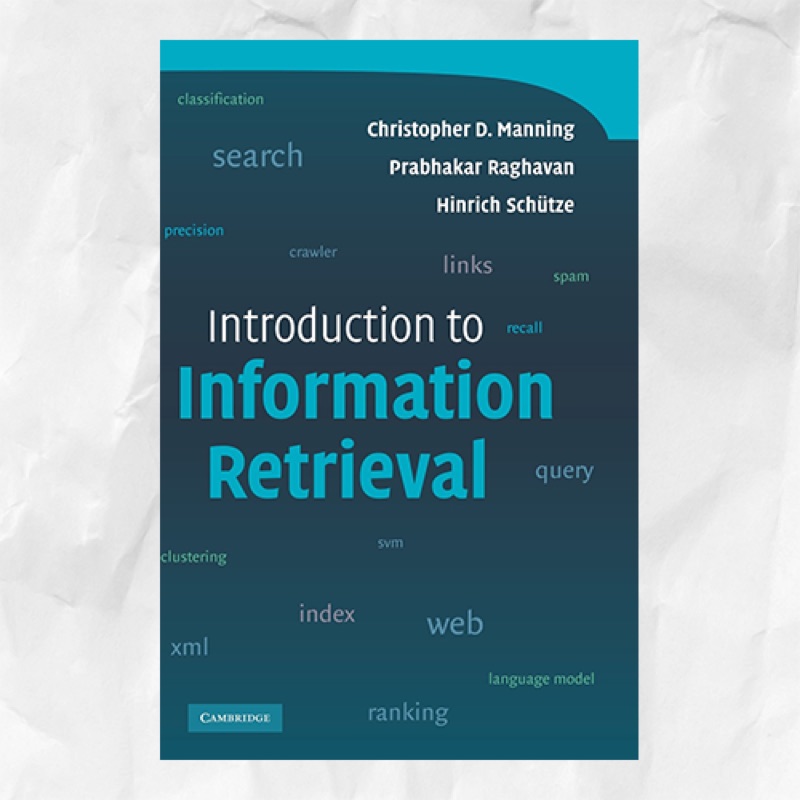
Cover of Introduction to Information Retrieval
📚 Book 2008 🇬🇧

Christopher D. Manning, Prabhakar Raghavan, Hinrich Schütze

Signal Processing and Information Theory

Introduction to Information Retrieval

Learning 💪
This 496-page textbook offers a thorough grounding in search engine technology, text classification and web information retrieval. It covers everything from Boolean and vector space models to crawling, indexing, query expansion and large-scale data handling.

Loving 💜
Despite the leaps in NLP and semantic search, I find this book impressively relevant. It is packed with foundational insights that modern techniques still build upon: indexing, ranking and evaluation ideas that today's retrieval-augmented systems reuse almost verbatim, even when nobody credits them anymore. The blend of theory, real-world examples and thoughtful exposition makes it timeless.

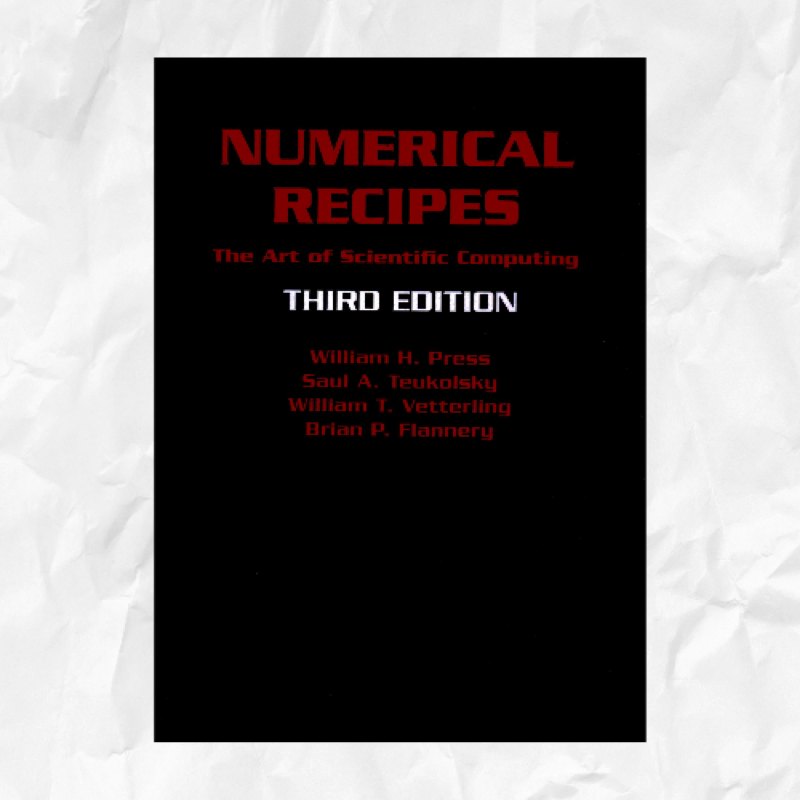
Cover of Numerical Recipes, 3rd Edition
📚 Book 2007 🇬🇧

William H. Press, Saul A. Teukolsky, William T. Vetterling, Brian P. Flannery

Algorithms and Optimization Programming

Numerical Recipes, 3rd Edition

Learning 💪
This 1256-page classic covers a wide array of scientific computing techniques (linear algebra, numerical methods, algorithm design) and is especially valuable for implementing high-performance algorithms in C/C++ or Fortran.

Loving 💜
I keep returning to it after many years. It is practical, sharp and written by top minds who clearly care about precision and usability: the kind of book whose recipes you can drop straight into working code, which is rarer than it sounds among scientific references. Whether you are building prototypes or production-grade software, this book is a serious companion.

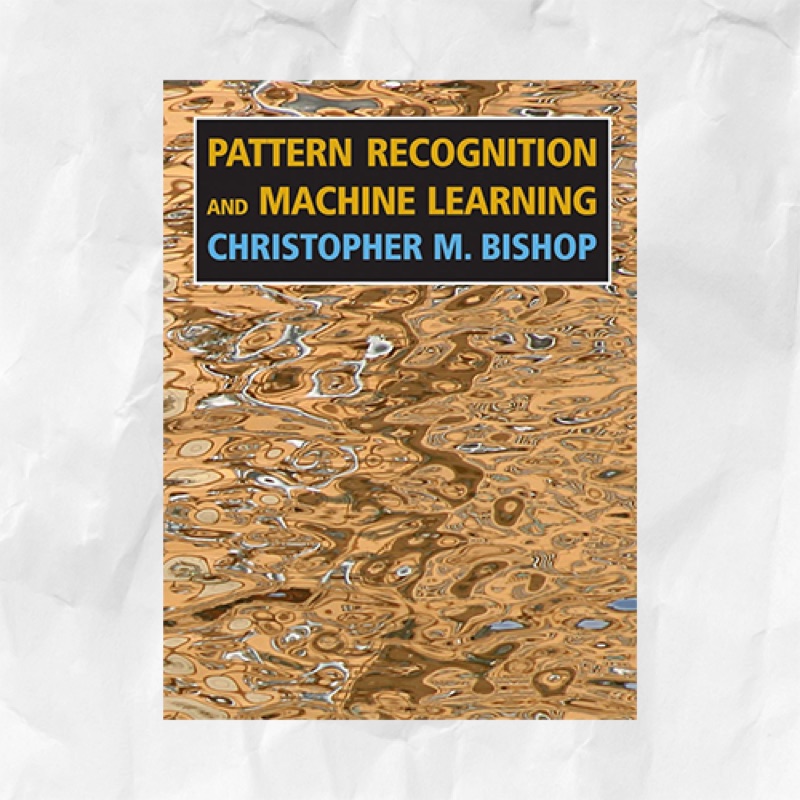
Cover of Pattern Recognition and Machine Learning
📚 Book 2006 🇬🇧

Christopher M. Bishop

Machine Learning / Data Science / Deep Learning

Pattern Recognition and Machine Learning

Learning 💪
This book offers a comprehensive and carefully guided introduction to machine learning, with a strong emphasis on practical modeling while maintaining mathematical rigor. Christopher Bishop presents a wide range of techniques, from linear models and mixture models to graphical models and neural networks, using a consistent probabilistic notation throughout.
The exposition is particularly well suited to practitioners: complex ideas are introduced progressively, supported by intuitive explanations, worked examples and clear connections between models.

Loving 💜
I find this book uniquely balanced. It never oversimplifies, yet it actively helps the reader move forward. It is the best machine learning book for practitioners who want to build real systems while still understanding the underlying principles. What I notice every time I reread a chapter is how the geometric intuition is never decorative: the figures are doing real mathematical work, carrying an argument that would take paragraphs to state in equations alone.
Pedagogically rich and remarkably well structured, it is a book I keep returning to, both for learning new ideas and for explaining them to others.

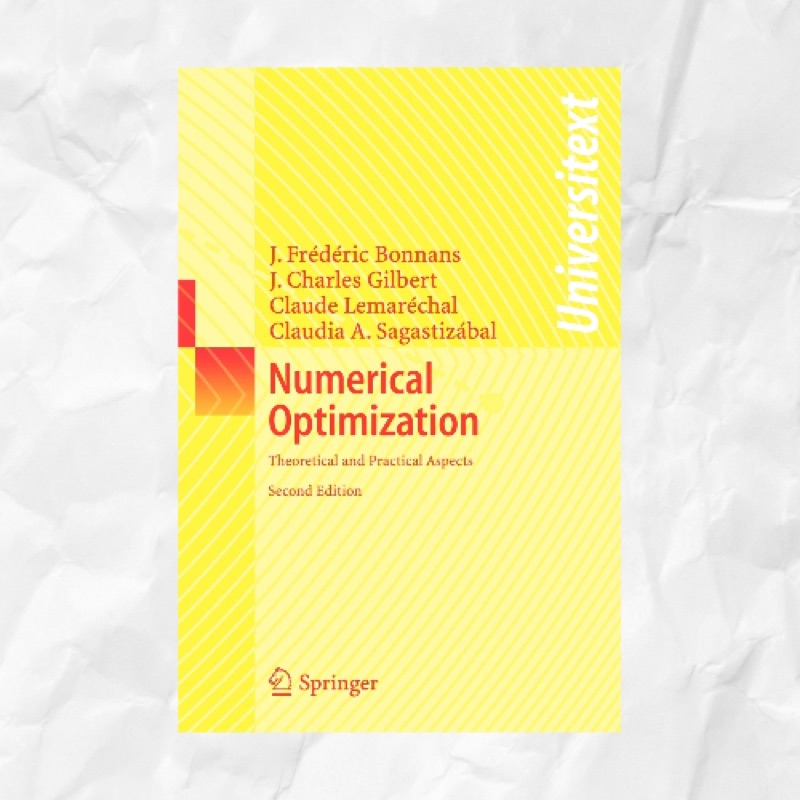
Cover of Numerical Optimization, 2nd Edition
📚 Book 2006 🇬🇧🇫🇷

J. Frédéric Bonnans, J. Charles Gilbert, Claude Lemaréchal, Claudia A. Sagastizábal

Algorithms and Optimization

Numerical Optimization, 2nd Edition

Learning 💪
This book provides a unified and remarkably clear treatment of numerical optimization, covering unconstrained and constrained problems, smooth and nonsmooth methods and algorithms used across machine learning, signal processing and scientific computing. The focus is consistently on how optimization algorithms actually behave when implemented, not just on their idealized theoretical properties.
Unlike many texts that emphasize either abstract theory or narrow algorithmic recipes, this book strikes a rare balance.

Loving 💜
This book is, in my opinion, seriously underrated. It does not enjoy the same visibility as some classics, yet it often provides the missing clarity when modern optimization discussions become vague or oversimplified. Its authors are the kind of people who built parts of the nonsmooth-optimization machinery they are writing about, which is probably why the treatment feels so unusually careful about exactly the edge cases (non-differentiability, large-scale decomposition) where flashier textbooks tend to wave their hands.
I regularly return to it when I need to understand why an algorithm works, or fails, in practice. For anyone who wants a deep, reliable understanding of optimization beyond fashionable methods, this book is a quiet gem and a long-term reference.

Cover of Algorithms
📚 Book 2006 🇬🇧

Sanjoy Dasgupta, Christos H. Papadimitriou, Umesh V. Vazirani

Algorithms and Optimization

Algorithms

Learning 💪
Grown out of more than a decade of course notes at UC Berkeley and UC San Diego, this 320-page book takes a strikingly different route from the encyclopedic algorithms texts: it tells a story. Divide-and-conquer, graph algorithms, greedy methods, dynamic programming, linear programming, NP-completeness and even randomized and quantum algorithms are each introduced through their essential idea first, with formal proofs arriving only once the intuition is secure. Sanjoy Dasgupta, Christos Papadimitriou and Umesh Vazirani write with the authority of active researchers in complexity theory and randomized computation. This kind of book made me more creative algorithmically when tackling industrial problems at scale.

Loving 💜
What I love about this book is its economy: barely 300 pages of actual content, yet nothing essential is missing, the fruit of more than a decade of course-testing distilled into exactly what survives contact with real students. As a practitioner I have never seen a better dynamic programming chapter. I must admit I know it by heart now. I am also a big fan of the quantum algorithms chapter.
It is the book I hand to someone who wants to genuinely enjoy learning algorithms rather than trudge through them, and the one I reach for myself when I want the shortest path back to why an algorithm works rather than just how to implement it. A perfect, leaner companion to heavier references like Cormen et al., narrower in scope, but wonderfully sharp and full of character.

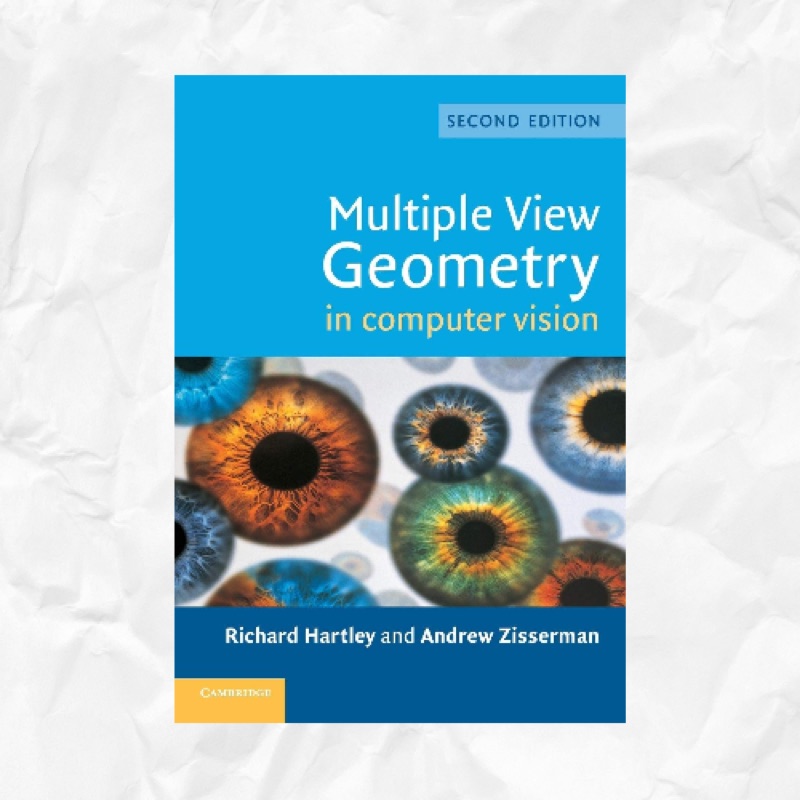
Cover of Multiple View Geometry in Computer Vision
📚 Book 2004 🇬🇧

Richard Hartley, Andrew Zisserman

Computer Vision

Multiple View Geometry in Computer Vision

Learning 💪
This book is a foundational reference on the geometric principles underlying computer vision. It develops the mathematical and algorithmic tools needed to understand images captured from multiple viewpoints, covering projective geometry, epipolar geometry, camera calibration, 3D reconstruction and motion estimation with exceptional rigor and clarity.
This classic book shows how strong geometric constraints can dramatically simplify vision problems.

Loving 💜
I increasingly find this book indispensable: the kind of reference an entire generation of vision researchers keeps within arm's reach on a physical desk, not just in a browser tab. It reminds us that better vision systems do not necessarily come from more data or larger models, but from a deeper understanding of the structure of the physical world and how it is projected onto images.
In a field where complexity can easily spiral, this book stands as a powerful argument for geometry as a source of elegance, stability and long-term robustness in computer vision systems.

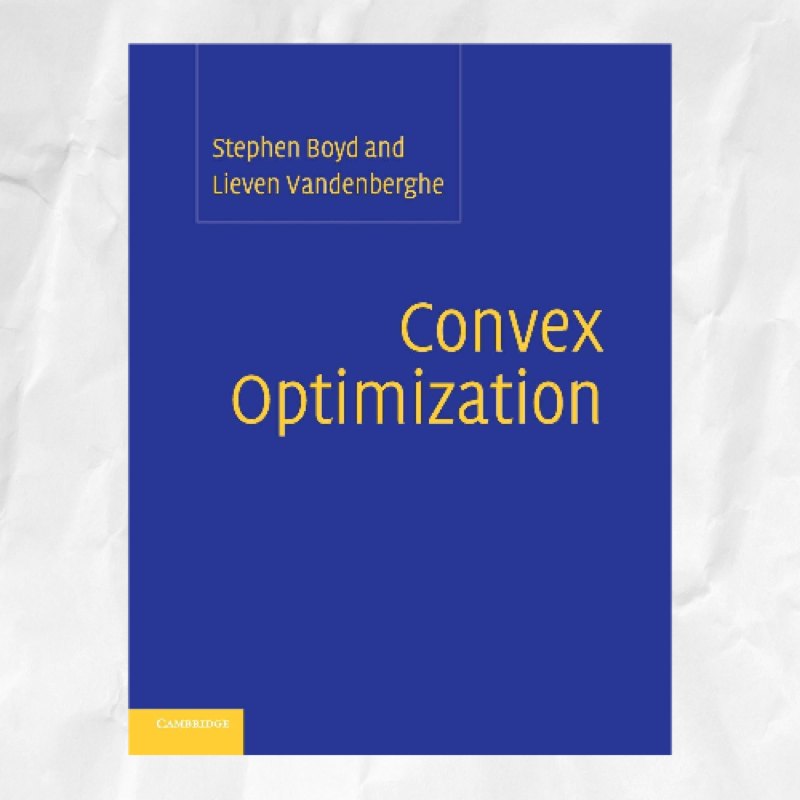
Cover of Convex Optimization
📚 Book 2004 🇬🇧

Stephen Boyd, Lieven Vandenberghe

Algorithms and Optimization

Convex Optimization

Learning 💪
This foundational 727-page text introduces convex optimization as a core tool for solving problems in machine learning, signal processing and beyond. It explains how convex methods provide both exact solutions to structured problems and principled approximations to harder, non-convex ones.
More than a collection of techniques, the book teaches how to think in terms of convexity: how to identify structure, design relaxations and reason about optimality, stability and sensitivity.

Loving 💜
I love how gentle yet rigorous this book is. The exercises are brilliant, often genuine inspiration for real research rather than routine drills. I also cannot separate my appreciation of the book from the fact that the authors chose to give it away freely online rather than lock it behind a paywall, which feels entirely in character for a book about finding the most efficient path to a solution. With CVXPY as a natural companion, the material becomes not just theoretical, but practically indispensable.
This is a book that quietly reshapes your intuition: once you have worked through it, many optimization problems suddenly look simpler, cleaner and more structured.

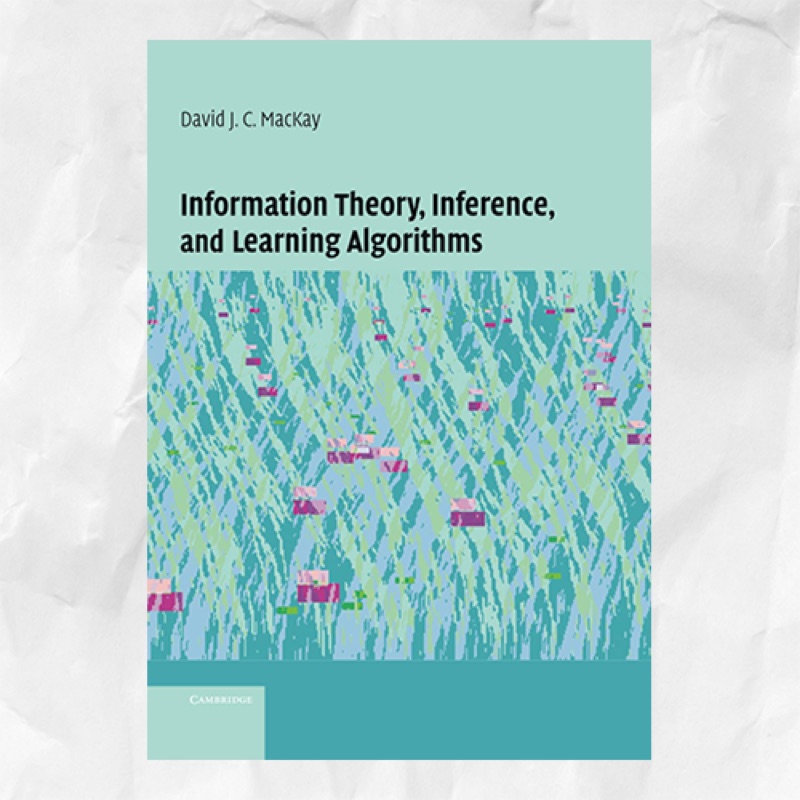
Cover of Information Theory, Inference and Learning Algorithms
📚 Book 2003 🇬🇧

David MacKay

Signal Processing and Information Theory

Information Theory, Inference and Learning Algorithms

Learning 💪
This 640-page classic connects information theory, Bayesian inference and machine learning in an insightful yet approachable way. It covers foundational principles while remaining relevant decades after its release, with intuitive examples and practical depth.

Loving 💜
I admire how MacKay bridges rigorous theory and real-world application. What I find touching, beyond the content itself, is that he made the entire book freely available online from the start: a small act of generosity that feels perfectly consistent with a book about information and inference being genuinely shared rather than gatekept. From error-correcting codes to probabilistic graphical models, this book offers lasting value for anyone building a solid intellectual toolkit in AI or data science.

Cover of Foundations of Statistical Natural Language Processing
📚 Book 1999 🇬🇧

Chris Manning, Hinrich Schütze

Natural Language Processing

Foundations of Statistical Natural Language Processing

Learning 💪
This 620-page classic lays out the foundations of statistical natural language processing before the deep learning era. It covers core topics such as part-of-speech tagging, probabilistic grammars, parsing, topic modeling and information retrieval with remarkable clarity and depth.
What makes this book particularly valuable is its emphasis on problem formulation. Language is treated as structured data, shaped by ambiguity, sparsity and noise, long before large neural models entered the picture.

Loving 💜
Even beyond NLP, I value this book for its disciplined and methodical approach to preprocessing and modeling. It teaches how to decompose complex problems into tractable components and how to reason about uncertainty in symbolic and semi-structured data. I keep noticing how many "new" evaluation and generalization debates around today's language models are really old debates from this book, restated with different vocabulary.
It has aged remarkably well. Many of the challenges faced by today's large language models (data sparsity, evaluation, compositionality and generalization) are already articulated here with precision. A timeless reference for anyone who wants to understand NLP beyond surface-level performance.

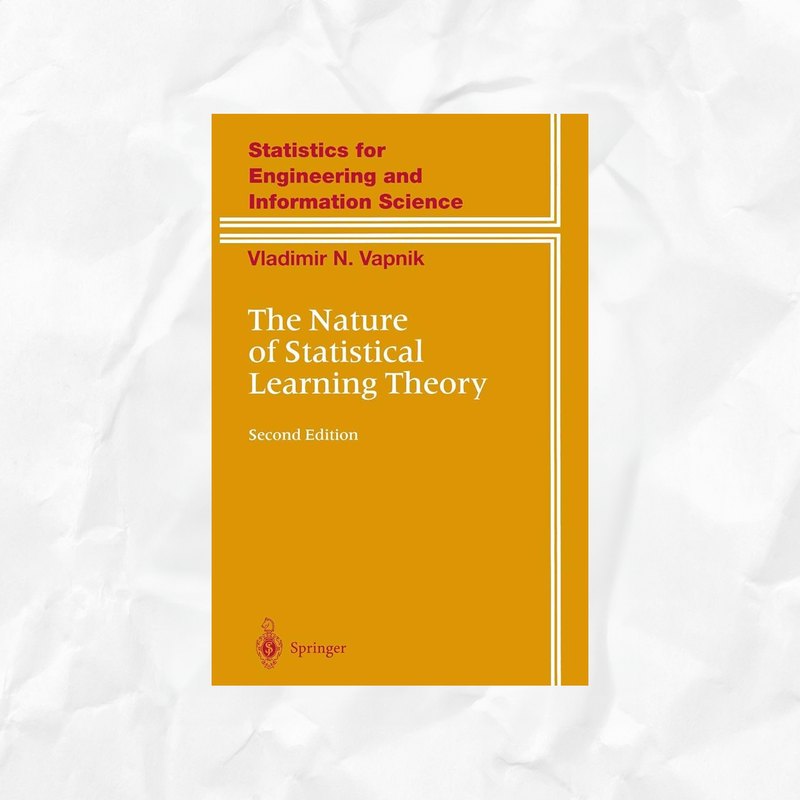
Cover of The Nature of Statistical Learning Theory
📚 Book 1995 🇬🇧

Vladimir N. Vapnik

Machine Learning / Data Science / Deep Learning

The Nature of Statistical Learning Theory

Learning 💪
This is where VC dimension, structural risk minimization and the theoretical foundations of support vector machines come from: the mathematics that explains why learning from finite data generalizes at all.

Loving 💜
It reframed how I think about overfitting and model capacity: not as a craft rule of thumb, but as a consequence of a clean, provable theory. What stays with me is that an entire family of algorithms I use routinely, support vector machines and everything downstream of the margin idea, is really just this theory made operational. That is a rare thing to trace all the way back to a single book.

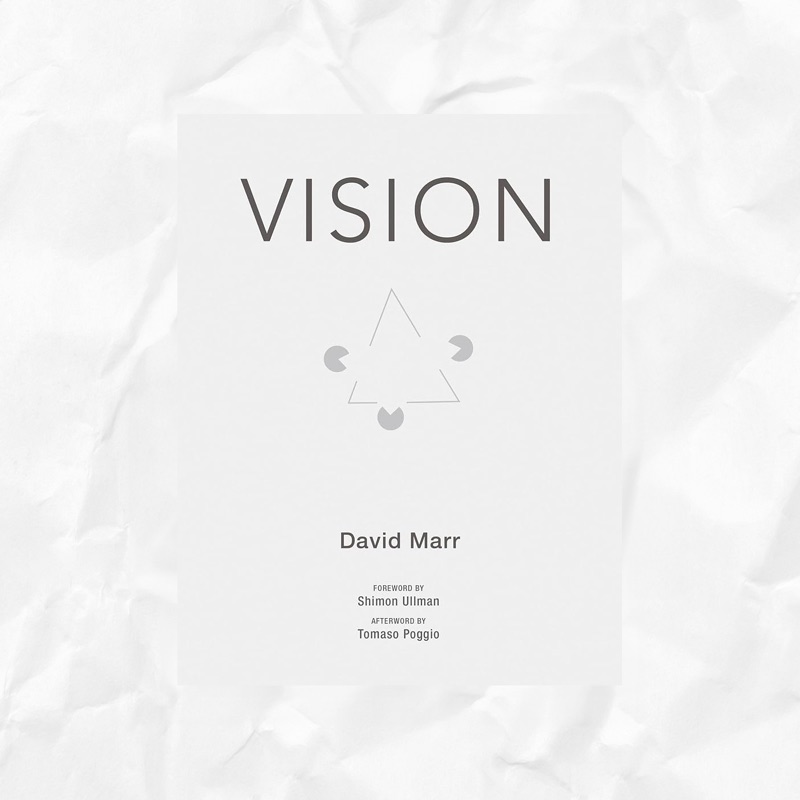
Cover of Vision: A Computational Investigation into the Human Representation and Processing of Visual Information
📚 Book 1982 🇬🇧

David C. Marr

Computer Vision Algorithms and Optimization Philosophy & History of Technology

Vision: A Computational Investigation into the Human Representation and Processing of Visual Information

Learning 💪
Published posthumously, this book is a cornerstone of computer vision. David Marr introduces his three-level framework (computational, algorithmic, implementational), which remains influential today. He develops a theory that bridges neuroscience, mathematics and computer science, at a time when neither powerful hardware nor modern software tools existed.
Loving 💜
What I love most is witnessing the creativity of researchers working with extremely limited resources. Marr's three-level split (computational, algorithmic, implementational) is one of those rare ideas that quietly organizes how I approach almost any system, not just vision: first ask what problem is being solved and why, only then worry about the algorithm and the hardware. Decades later, the questions he posed about representation and 3D structure are still not fully closed, which tells me more about the depth of his framing than about how much has changed. His intellectual clarity makes this book an enduring source of inspiration, far beyond computer vision alone.