
September 2025. Nvidia, the company whose chips run most of today's AI, announces that it will invest in OpenAI, the maker of ChatGPT. A few days later we learn that OpenAI will buy chips from Nvidia. The financial press finds a name for it at once: "circular financing". The seller hands money to its customer, who hands it straight back as orders. Like a shopkeeper who slips a tenner into every customer's pocket just before the till.
That shopkeeper would post record sales without a single customer spending their own money. The figures would be a mirage. If the whole AI industry worked that way, the biggest wave of investment of our time would stand on thin air.
It is a vivid picture. It is also a frightening one. Best of all, you can measure it. The Bank for International Settlements, the bank of the central banks, has done so over five years of deals between start-ups and giants. I wanted to measure it at the top of the industry, one amount at a time. So I got out my calculator.
If you are in a hurry, here is what I found. The loop exists, but it is small: out of every hundred dollars of purchases, fewer than eight come out of the seller's own pocket. Everything else depends on a promise, made by AI labs that pledge to spend revenue they have not yet earned. In the middle of the chain, the companies waiting for that revenue borrow to build. Their debt is the real story.
A big ledger, pair by pair
I began by listing 69 companies that make or buy AI. Some build the hardware: Nvidia designs the chips, TSMC manufactures them, ASML makes the machines that etch them onto silicon. Some rent out computing power: Amazon, Microsoft, Google, Oracle, CoreWeave. Some are the labs that design AI models: OpenAI, Anthropic, Mistral, DeepSeek. The rest put AI to work inside their own software.
For every pair of companies I asked four questions. Does A buy from B? Does B buy from A? Does A invest in B? Does B invest in A? The answers were collected by AI agents, programs I set to read annual reports, stock exchange filings and press articles. Each answer comes with its source and its amount, or with the words "not disclosed". In all I found 472 money flows, 412 of them still running on 22 November 2026. I added 135 flows between governments and these companies.
AI agents make mistakes. So I had 85 lines, picked at random, checked against their sources. Five of them held a serious error: a wrong amount, or a flow running the wrong way. I fixed them, then hunted for the same error across the whole ledger.
Every number in this post says where it comes from, in bold right after it:
- measured: I computed it from the ledger;
- estimated: I, or an analyst, computed it from published quantities;
- reported: a company, a regulator or the press published it as it stands.
Yes, sellers invest in their customers
Investing in someone means buying a piece of their company. That piece is called a stake. Put money into your neighbourhood bakery in exchange for a tenth of its shares and you own a tenth of the bakery. You collect a tenth of its profits. If the bakery closes, you lose what you put in.
AI companies do this among themselves, a lot. Of 101 current investments, 57 link a customer and its supplier. Those 57 make up 97% of the dollars invested (measured). Economists have a name for the practice: vendor financing. Think of the car dealer who helps you pay for the car he is selling you. At the top of AI, investing in your own customer is the rule.
On this first point, the worriers are right. What remains to be seen is how much of that money comes back.
No, the money barely comes back
Take Amazon. It invested $50 billion in OpenAI. OpenAI promised to buy $138 billion of computing from Amazon. Assume the worst: every dollar Amazon put in goes straight back to Amazon as orders. Amazon's own money would then pay for 36% of those purchases. The other $88 billion have to come from somewhere else.
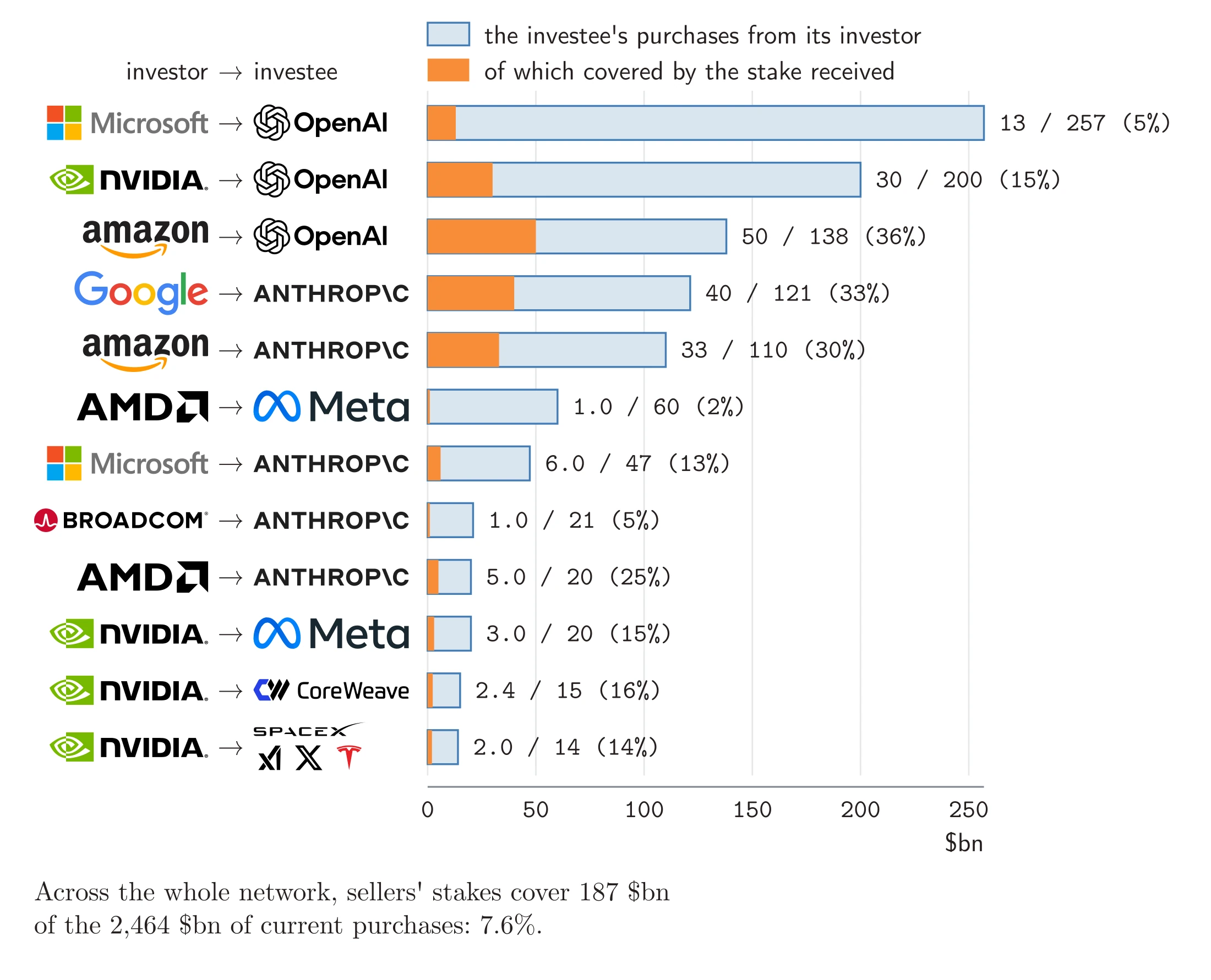
I ran that sum for every pair, then for the whole network. The sellers' stakes cover $187 billion out of $2,464 billion of current purchases: 7.6% (measured). Fewer than eight dollars in a hundred.
There was a snag. More than half the flows, 241 out of 412, have no published amount. A contract to rent computing power lasts one year or five. Its length is not always disclosed. So I redid the calculation 8,000 times. Each run drew a random size for every hidden amount, let every estimate swing from half to double and changed the length of the contracts. The answer turns from a single number into a range: the share stays between 1.7% and 7.6% (measured). The worst case I found is the one I gave you.
A round trip between two companies misses the longer loops. Nvidia invests in OpenAI, which buys from Oracle, which buys from Nvidia. The money does come home, by a detour. To count every detour, I borrowed a tool from ecologists: Finn's cycling index, devised in 1976. In a forest, an atom of nitrogen travels from a leaf to the soil, from the soil to a root, from the root to a new leaf. Finn's index measures what share of everything moving through the forest passes again through the same living things. I applied it to dollars instead of nitrogen.
The index stays below 4.2% (measured). At most forty-two dollars in a thousand come back to where they started, however long the loop. The AI forest recycles very little. Money comes in at one end and leaves at the other.
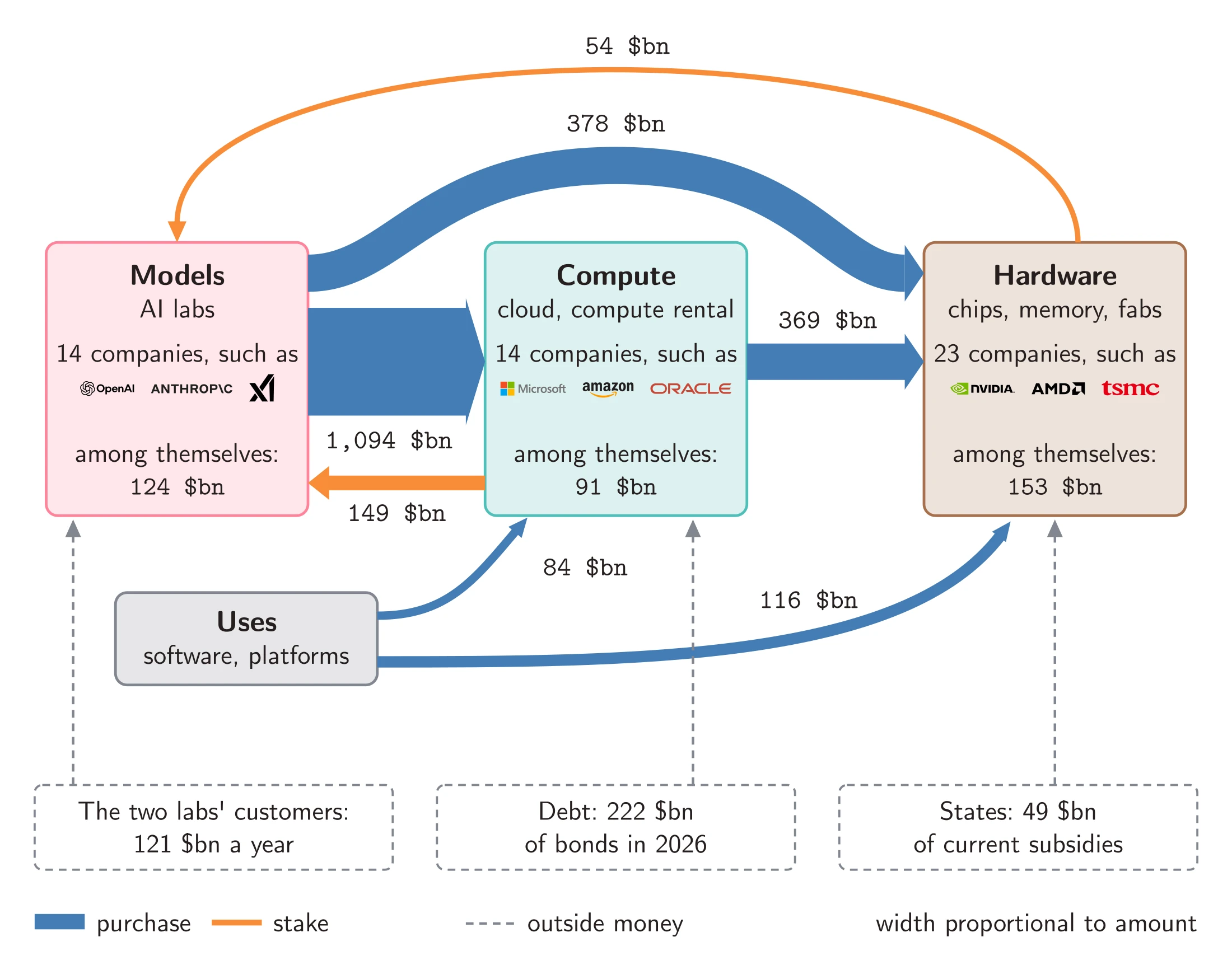
The loop is open. The sellers' money pays for only a small part of their sales. So who pays for the rest?
What replaces the loop: a promise
The answer is simple: the end customers. You, me, the businesses that pay for a subscription to ChatGPT or Claude. The catch is that a good part of that revenue has yet to arrive.
Anthropic, the maker of Claude, has just filed to list its shares on the stock market. The filing is the file a company hands the market regulator before it sells shares to the public. The law requires it to disclose everything that matters. In it you read $900.9 billion of promises to buy computing power and revenue running at $81 billion a year (reported). A quick check of the order of magnitude: 900 divided by 81 makes eleven years of revenue.
Eleven years! Time to panic? Not for the coming year. Over the next twelve months, Anthropic owes $70.7 billion and takes in $81 billion, a ratio of 0.87 (measured). Today's revenue covers tomorrow's bills. Through to 2030, though, the average promise comes to $106 billion a year, 1.31 times current revenue (measured). To keep up, that revenue has to keep growing.
OpenAI publishes no accounts. Its boss has announced $1,400 billion of commitments over eight years, or $175 billion a year, against revenue the press puts at $40 billion. Each year, OpenAI promises 4.4 times what it takes in (measured, from reported figures).
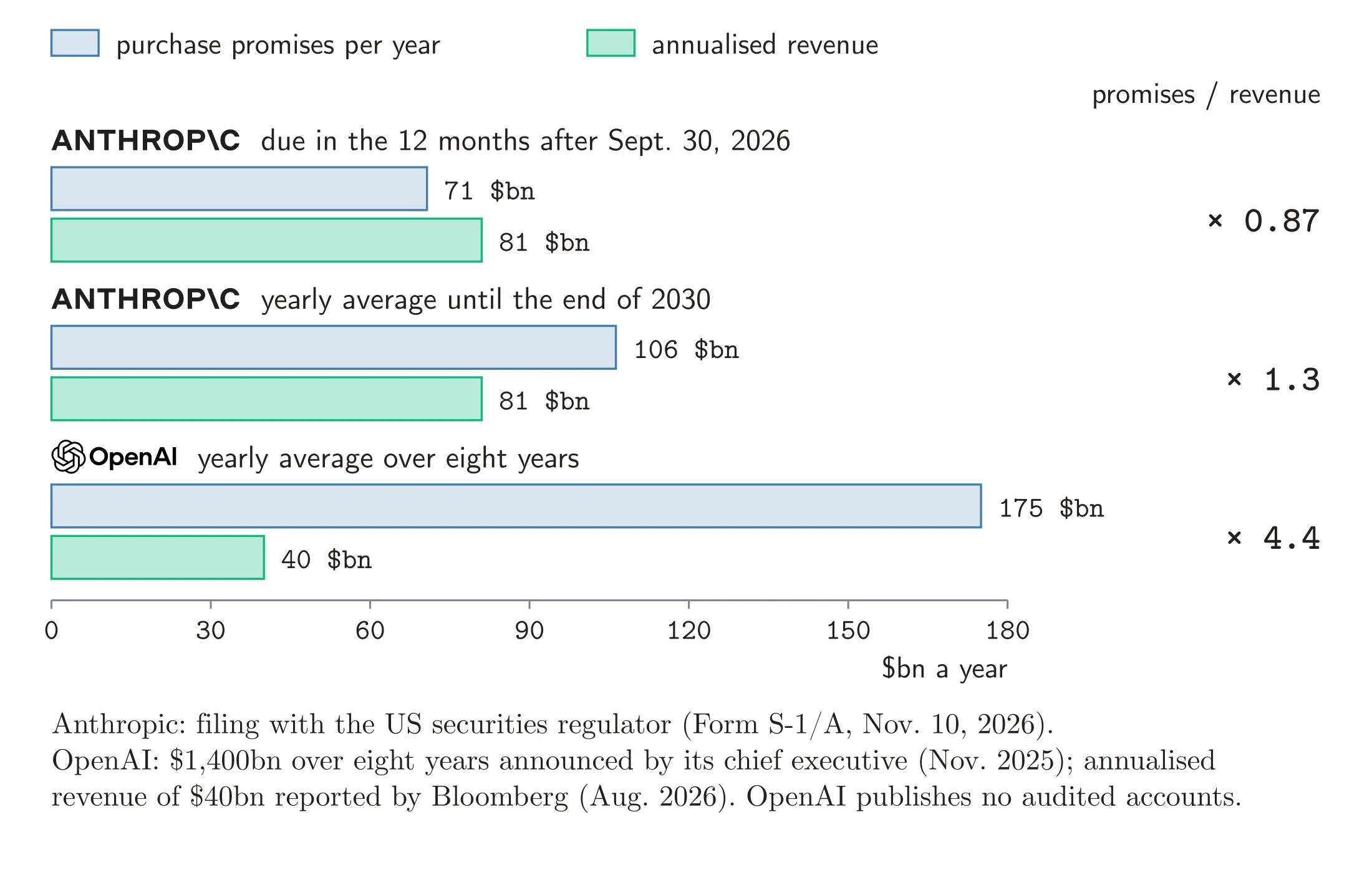
Is that madness? Not necessarily. A young company that grows fast always signs contracts against its future revenue, much as a graduate signs the lease on a flat counting on the salary from a first job. The risk changes shape. The question used to be whether the money goes round in circles. It becomes: will the revenue arrive fast enough?
Who is waiting to be paid
A promise to buy is good news for whoever receives it, as long as the customer pays. I wanted to know which sellers depend most on these promises. To compare a small company with a giant, I divided the promises each seller has received from the two labs by its market value, the price of all its shares put together.
Nvidia, the target of every worry, has received promises worth 0.066 times its market value. Oracle has received 0.95 times (measured). Fourteen times more. CoreWeave, a smaller firm that rents out computing power, reaches 0.84 times counting firm money only (measured). Two other renters, Fluidstack and Nscale, climb to 6.7 and 3.1 times their value, but their contracts are ceilings ("up to…") with nothing firm.
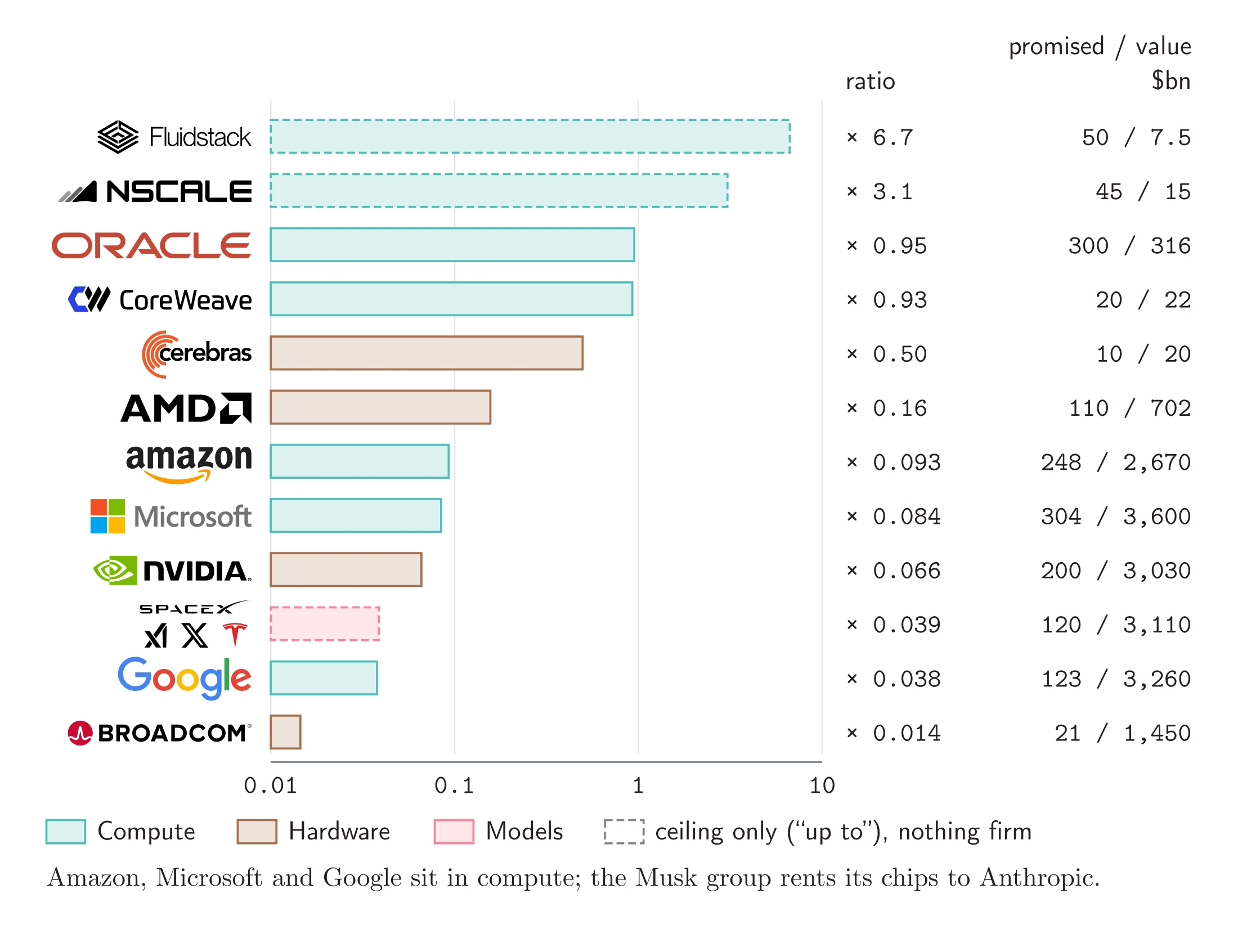
Why the renters? A compute renter works like a car hire firm. It pays for its fleet of chips on delivery. Then it waits for its rent, month after month, over five-year contracts, from a handful of customers. Nvidia has already been paid for its chips. The renter is still waiting.
Those who wait borrow
The renter lacks the cash to buy its chips and build its data centres, so it borrows. I had the debt that finances AI recorded line by line. Before giving the total, a few words of the trade.
- A debt is money you pay back on a fixed date, plus interest. A shareholder who loses their stake has no recourse. An unpaid lender can seize whatever was pledged as security.
- A bond is an IOU cut into small pieces and sold to thousands of lenders: pension funds, insurers, savers.
- The coupon is the interest a bond pays each year. The name comes from the old paper bonds, from which you clipped a coupon to collect your interest. The warier the lender, the higher the coupon it demands.
- Private credit means funds that lend straight to companies, without going through a bank or the stock market.
- The balance sheet is a snapshot of what a company owns and what it owes. An off-balance-sheet debt was borrowed by a company next door, for instance the developer putting up the building the company will rent. The snapshot leaves it out, yet the company will pay the rent that pays it off.
Depending on what you count as AI debt, the total runs from $242.7 billion to $1,000.5 billion. My middle reading adds to the debt tied directly to AI the general bonds that the sector's big spenders have issued since September 2025. It comes to $664.9 billion (measured).
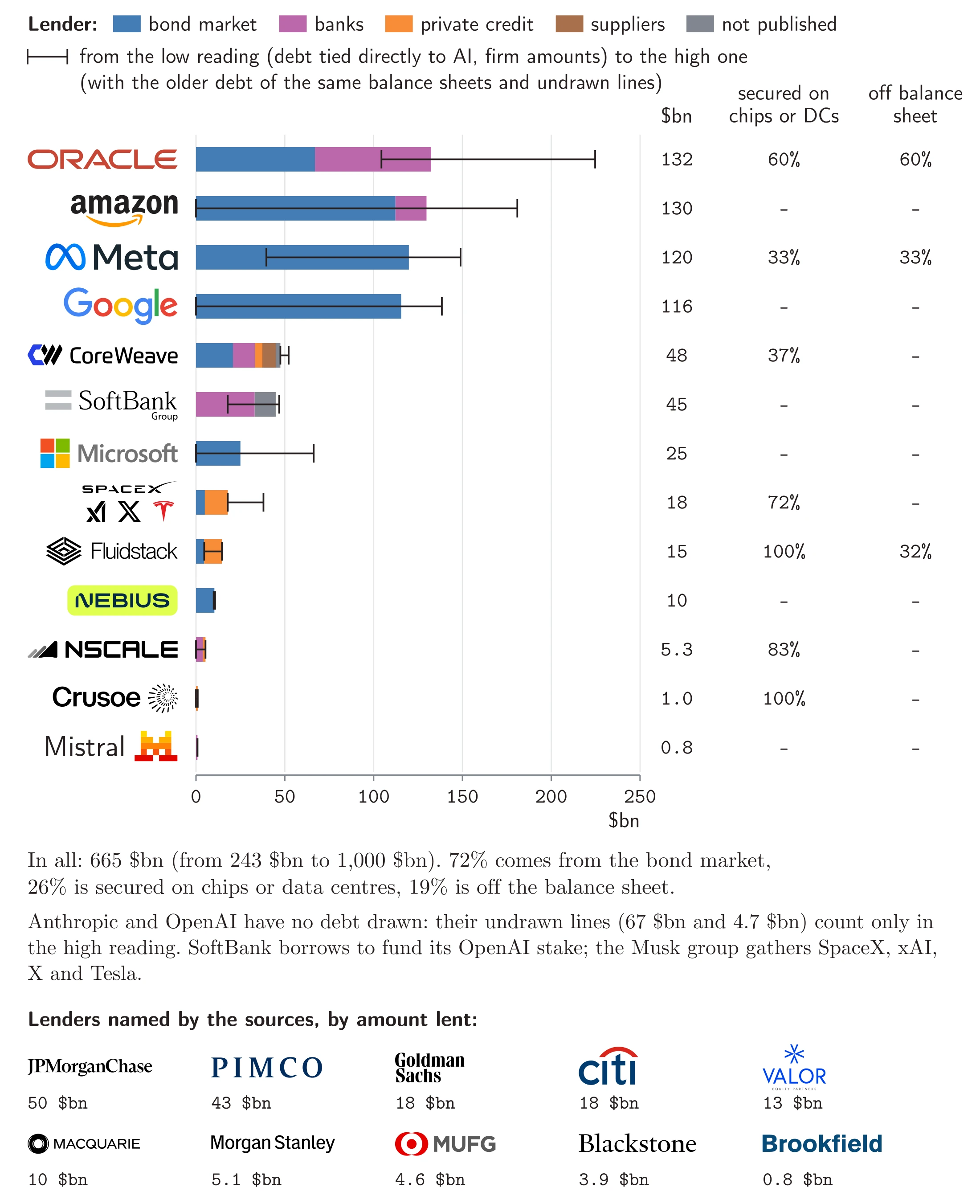
Look closely at CoreWeave. It owes $47.5 billion: 2.16 times its market value, 2.33 times what the two labs have promised it (measured). More than half of that debt, 58.6%, has to be repaid or rolled over before the end of 2030. CoreWeave's bonds pay a coupon of 9% to 9.75% a year. Lenders charge a high price for their trust.
Oracle owes $132.4 billion tied to AI. Of that, $79.4 billion was borrowed by the developers of its data centre campuses, off its balance sheet, according to the press. On top of that come $288 billion of rent on leases that have not started yet. Oracle's coupon works as a thermometer: 4.45% to 6.10% in September 2025, 7.00% to 8.65% in November 2026. In one year, lenders have grown warier.
At the top of the chain, Anthropic and OpenAI have drawn no debt. They live on their shareholders' money.
Who lends? The bond market holds 72.2% of this debt, banks 20.0%, private credit 4.4% (measured). That mix reads both ways. Bonds belong to savers, insurers and funds that lend their own money: if the borrower defaults, they lose, but no bank branch shuts its doors. In the direct debt, though, the debt of the campuses and the renters, banks rise to 34.6%. Nearly two thirds of that direct debt is secured on chips or data centres. And a chip is worth the rent it earns. If the price of computing falls, the security melts just when the borrower struggles to pay.
What about governments?
I expected to find public money in the middle of the chain, where the risk gathers. It comes in at both ends.
At the bottom, subsidies. The twelve I could put a figure on all go to chip or memory factories, $49.4 billion in total (reported): TSMC in Arizona, Japan and Germany, Micron, Samsung, SK hynix, Tata in India. At the top, sovereign wealth funds from the Gulf and Singapore, which invest a country's savings, buy into OpenAI, Anthropic or xAI, almost always without saying how much. In the middle, the six compute renters receive three public flows, none with a figure attached (measured).
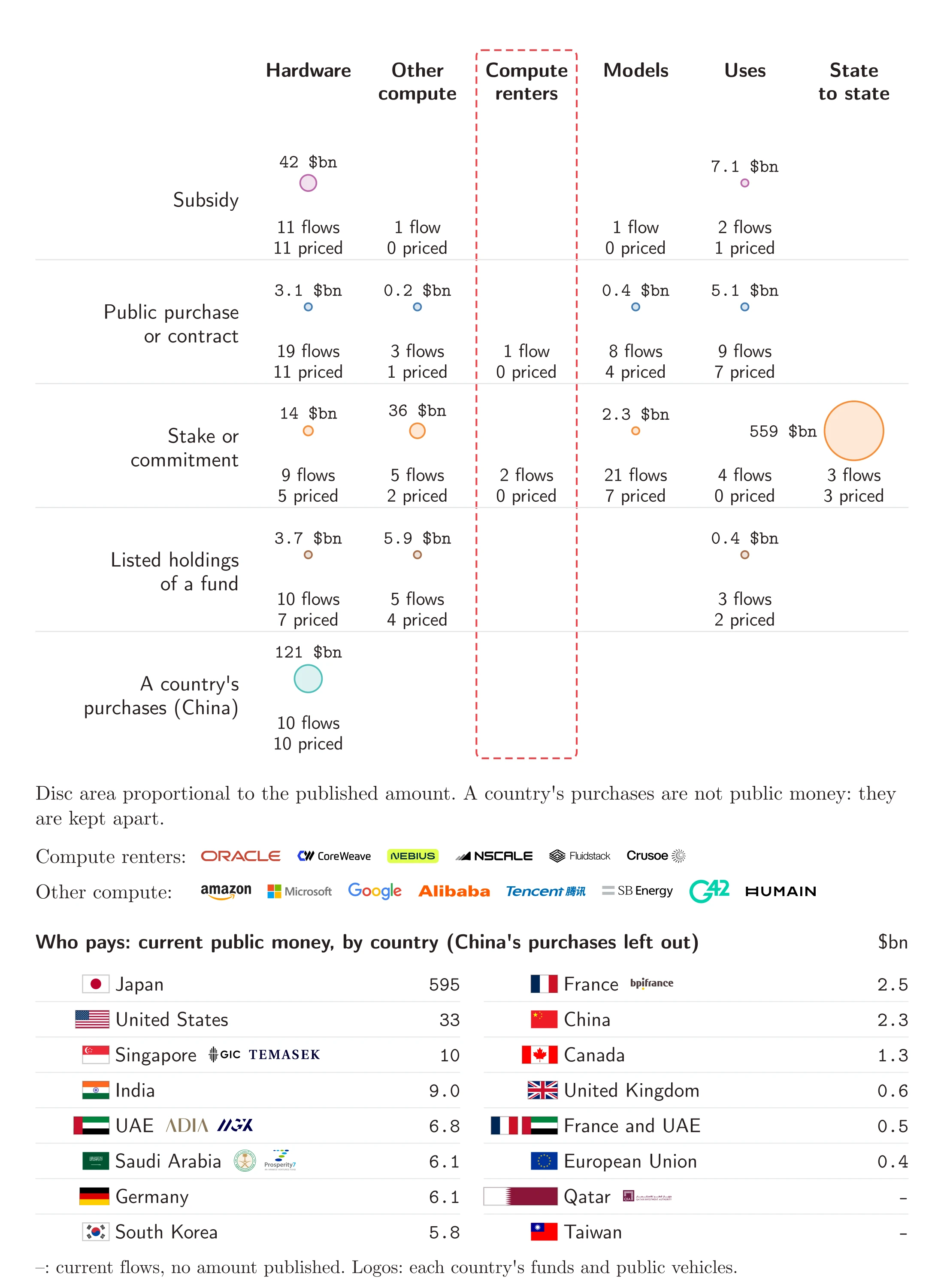
Governments pay for what lasts: factories. They also bet on the labs at the top. The link that borrows the most receives no public money with a figure on it.
Reasons to worry, reasons not to
I set no value beyond which everything would tip over. Any such threshold would be arbitrary. For each number, I would rather say what is worrying about it and what is reassuring.
The loop. A round-trip share of 7.6% at most is reassuring: the sellers' money does not manufacture their sales. I even pushed the measure against myself. Nvidia guarantees up to $105 billion of OpenAI's rent: if OpenAI fails to pay, Nvidia pays. Counted as money paid in, that guarantee lifts the share to 11.9% (measured). Yet the same smallness is worrying. If the money does not go round in circles, the promises are waiting on the future revenue of end customers.
The labs. Anthropic is reassuring in the short run: 0.87 times its revenue for the coming year. The ratio rises to 1.31 through 2030, so revenue still has to grow. OpenAI is more worrying, at 4.4 times its revenue every year. Even with the highest revenue estimate, from the news site Axios, the ratio only comes down to 2.5. The promise still outweighs the revenue.
The middle. Size for size, CoreWeave expects 5.3 times more firm money from the two labs than AMD does (measured). Risk gathers at the renters, who buy their chips with cash or on credit and depend on a few customers. A promise to buy is still an order book, an asset as long as the customer pays. Finally, the renters receive no public money with a figure on it. If one of them gave way, the state would lose no known sum. No public safety net would catch the renter either.
I also show what fails my tests. The two labs' share of all the industry's purchases ranges from 17% to 68% depending on the assumptions. So wide a range says nothing. I leave it out.
An industrial bubble? What Jeff Bezos says
A bubble is a price that climbs far faster than the thing is worth, pushed up by the enthusiasm of buyers. One day the enthusiasm fades. The price falls with it.
On 3 October 2025, in Turin, Amazon's founder Jeff Bezos said that AI is in a bubble. He is hardly worried. He sorts bubbles into two kinds. A banking bubble, like 2008, is "just bad". Industrial bubbles are "not nearly as bad": investors lose, then "society benefits from those inventions". His example is the biotech bubble of the 1990s, when young companies lost money but left life-saving drugs behind. Then came the fibre-optic cable of 2000. The companies that laid it went bankrupt, "but the fiber optic cable was still there and we got to use it". In May 2026, on the CNBC channel, he added that "the good ideas will pay for all of the losers".
Bezos does not spell out the mechanism. Here it is, as economists describe it.
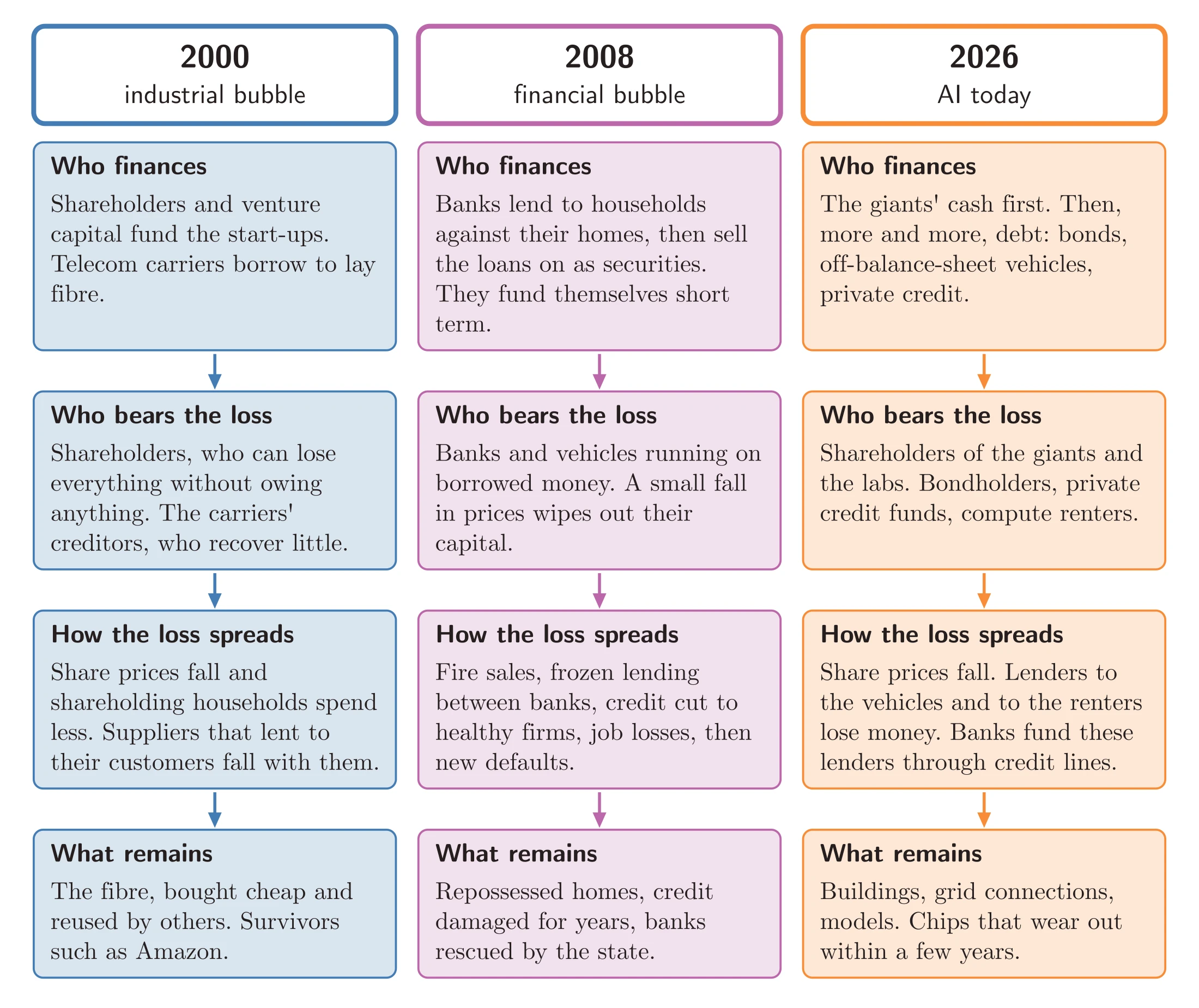
- 2008, a financial bubble. Banks lend people money to buy houses, with the house as security. Prices rise, so the security is worth more, so the banks lend more. They sell these loans on in bundles to other banks and to heavily indebted firms that fund themselves short term. When prices turn, a small loss wipes out their equity, the money that is their own. They sell in a panic, stop lending to one another and cut credit to healthy businesses. The state bails them out.
- 2000, an industrial bubble. Shareholders fund the internet start-ups. The Nasdaq index, which follows American technology shares, lost 78% from March 2000 to October 2002 (estimated, from the St. Louis Federal Reserve's data). The loss stops with the shareholder, who owes nobody anything. The networks of bankrupt companies are bought up cheaply and put to use by others.
Credit makes the difference. American households lost sums of the same size in both crises: $4,900 billion of shares from 1999 to 2002, $5,600 billion of property from 2006 to 2009 (reported, Federal Reserve accounts quoted by the economist Timothy Taylor). Yet the country's output, its GDP, fell 0.4% in 2001 and 4.0% in 2008 and 2009. The economy lost 2.6 million jobs the first time, 8.7 million the second (estimated). For a comparable starting loss, more than three times as many jobs disappear when the loss runs through the lenders. The economists Òscar Jordà, Moritz Schularick and Alan Taylor, who studied more than a century of bubbles, put it in one sentence: "what makes some bubbles more dangerous than others is credit".
Europe and China show the same mechanism in two other forms. In 2001 the euro area had no recession. Its employment grew every quarter while the German stock index, the DAX, lost 72.7% (estimated, Eurostat and Yahoo Finance). In 2008 the loss ran through the banks: GDP down 5.7%, 4.3 million jobs gone. Then the governments that had rescued their banks fell into debt in turn: the public debt crisis of 2010 to 2012 pushed unemployment to 12.3% in 2013. China never saw its GDP shrink. Its 2008 shock came from the global crisis: about 20 million migrant workers found themselves out of work in early 2009, according to a Communist Party adviser. Beijing answered with a 4 trillion yuan plan, two thirds of it paid for by borrowing, mostly by local governments. Public credit softened the blow by moving the debt.
Where AI stands
My ledger proves Bezos right on one point: AI money does not go round in circles. The sellers' stakes pay for only a small share of purchases (measured). That is a long way from a credit machine pumping up its own collateral. Public money mostly pays for chip factories, which will last.
Yet Bezos never mentions debt. AI financing is tipping towards it. My own records count $227.0 billion of bonds issued from January to September 2026 by the five biggest cloud giants, the companies that rent out computing over the internet. The Bank for International Settlements counts $222 billion, plus $75 to $100 billion of securities tied to off-balance-sheet companies (reported). The two counts, made independently, agree. The International Monetary Fund notes that these giants went from 0.5% of the bonds issued by sound companies in 2024 to almost 10% in 2026.
Other signs recall 2000. Nvidia's guarantee on OpenAI's rent is supplier credit, the mechanism that brought down telecom equipment makers in 2001. CoreWeave has pledged its servers as security for its loans. And what will be left wears out fast. The fibre served for decades. Meta counts its servers as lasting 5.5 years, a span the investor Michael Burry still finds too long.
The closest parallel, to my mind, is the telecom segment of 2000: infrastructure built on credit, whose lenders got back only about 16% of their money in 2002 (reported, Edward Altman and Gaurav Bana). AI looks less like 2008. Its debt runs for many years. Bondholders, insurers and funds hold most of it, more than banks funded by their customers' deposits. Three things would change that picture: banks' credit lines to those funds, shares bought with borrowed money and chips pledged as security whose value tracks the bubble itself.
What ordinary people pay
"Industrial bubble" describes what society keeps after twenty years. The phrase says nothing about who pays in between. Even the crisis of 2001, the "not nearly as bad" kind, had its victims. American unemployment rose from 3.8% to 6.3%. Enron's employees lost more than $1 billion of retirement savings, over 60% of it invested in their own employer's shares. The Canadian equipment maker Nortel went from about 94,500 employees to 45,000 in a year. Bezos tells the story himself: during the crash, his employees' parents rang them to ask whether they were all right.
Today the bill would land on other shoulders:
- savers: the seven biggest technology shares make up 33.7% of the S&P 500, the index of America's five hundred largest listed companies. A third of all savings placed in that index, the one behind the most common pension funds, depends on those seven;
- households paying for electricity: in the eastern United States, on the PJM grid, data centres have added $29.4 billion to the cost of keeping enough power stations on standby, whether or not the bubble bursts;
- public services: Virginia gave up $1.6 billion of tax in 2025 to attract data centres;
- service workers: the richest 10% of households account for 49.2% of American consumer spending, propped up by their AI shares. If those shares fall, those households spend less. Modest service jobs absorb the shock.
The long-run winners and the short-run losers are different people. Those who enjoyed fast fibre in 2010 were not the ones who had lost their jobs in 2002.
What I take away
I set out to hunt a loop. I found a chain. AI money barely goes round in circles: almost nothing the sellers invest comes back to them as orders. The chain hangs on promises. The labs pledge to pay out of revenue that has yet to arrive. The companies in the middle, waiting for that revenue, borrow to build: $664.9 billion of debt in the middle reading, $47.5 billion of it for CoreWeave, more than twice its market value (measured).
Bezos is right about what will remain: buildings, grid connections, models. He forgets the road that leads there. A bubble financed on credit does not stop at the shareholder. Even the gentle crisis of 2001 cost jobs and pensions to people who had bet nothing. If this one bursts, the bill will travel through bondholders, pension funds, savings placed in stock indexes and electricity bills.
Nobody knows whether the bubble will burst. Anyone can watch it grow, though, quarter after quarter, with three numbers:
- the two labs' revenue, set against what they promise to pay the following year;
- the firm share of the promises the compute renters have received;
- the renters' debt that falls due before 2031, with the coupon at which they roll it over.
When those three numbers move, you will know before the headlines do.
Every number in this post comes from the technical report, which gives the source and the method for each one. If you know of a money flow I have missed, write to me: warithmetics@deraison.ai.
Further reading
- The full technical report (PDF, English): every number with its source, its proof status and its method.
- Le rapport technique complet (PDF, français).
The figures in this article were made with sprezzature.ai by Deraison.ai
 sprezzature.ai
 Deraison.ai