
In ancient Greece, the mageiros was butcher, cook and sacrificer all at once. He cut up the animal by the rules, piece by piece, wasting nothing. Mageiros does the same with public speech: it cuts it down to the finest grain, then puts it back together as numbers anyone can check.
Take a TV debate. On July 1, 2026, at 5:40 p.m., the French channel France 5 airs C dans l'air, its daily current-affairs panel. The host, Caroline Roux, has four guests around one question: are Ukraine's strikes inside Russia weakening Vladimir Putin? Sixty-five minutes on set, five voices talking over one another.
The next day, ask anyone who watched three plain questions. Who spoke longest? Who cut in on whom? Where did the guests disagree? Nobody answers without sitting through the whole hour again, stopwatch in hand. Mageiros hands back its record in a few minutes.

The record of the July 1, 2026 episode: the embedded video, the recognised speakers, then tabs running from a one-line summary to the full transcript. It exports to PDF and Word. The interface is in French, like the corpus.
Cutting to the finest grain
I am obsessed with the grain of information. Get the grain right and everything else follows. Get it wrong and nothing holds. So it all starts from the word: every word has its start time and its end time. If those are off, no clever statistics will make up for it.
Ask an AI whether a guest “dodges questions” over an hour of television and you get an impression back. Mageiros never judges a person as a whole. The AI only works at the finest grain, where it makes the fewest mistakes:
- the word, timed to the hundredth of a second;
- the speaking turn, for stratagems, dodges and political position;
- the pair of replies, for agreement and disagreement.
The numbers for the episode, the person or the season are then built by adding up these small judgements, each tied to its quote and its second. That is what gives the aggregates their meaning: a total can be recounted, an average reopened. Every percentage unfolds down to the sentence it rests on.
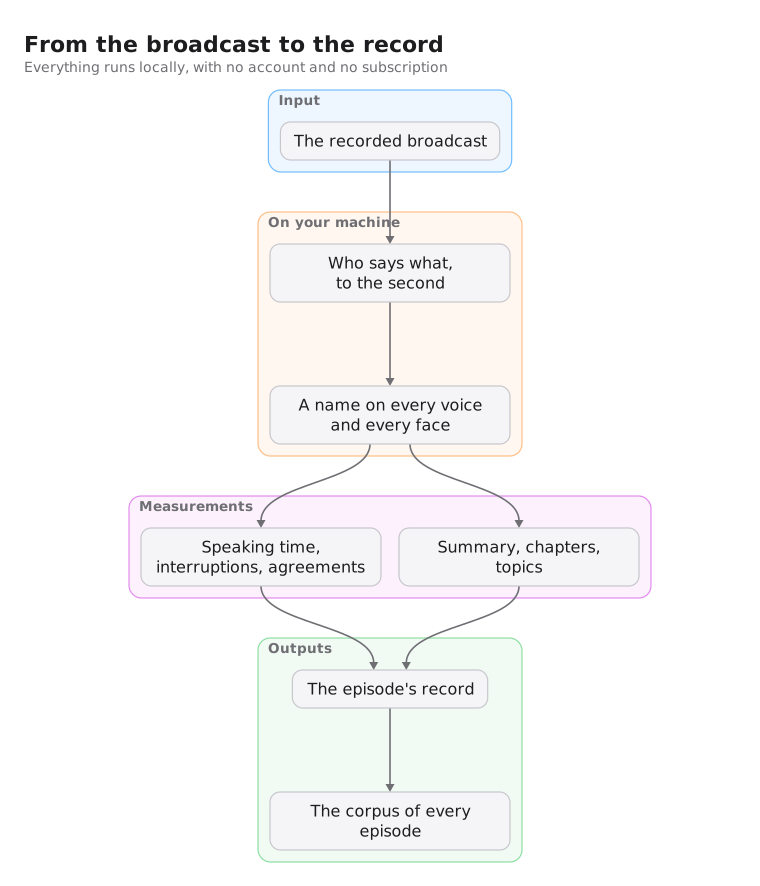
The Mageiros pipeline, from recording to corpus. Fully local, or on French cloud and AI.
A first model spots the moments when someone is speaking, a second tells the voices apart: that is diarization, the technical word for “who speaks when”. A transcription model writes down every word. A local vault keeps a print of every voice and every face: someone named once is recognised in later episodes, with the on-screen name captions as anchors.
Every number points to its second
A number without its source is taken or rejected. It cannot be argued with. So in the record, every line of the transcript shows its timestamp. One click restarts the video at that exact moment, so you can hear with your own ears what the machine wrote down.
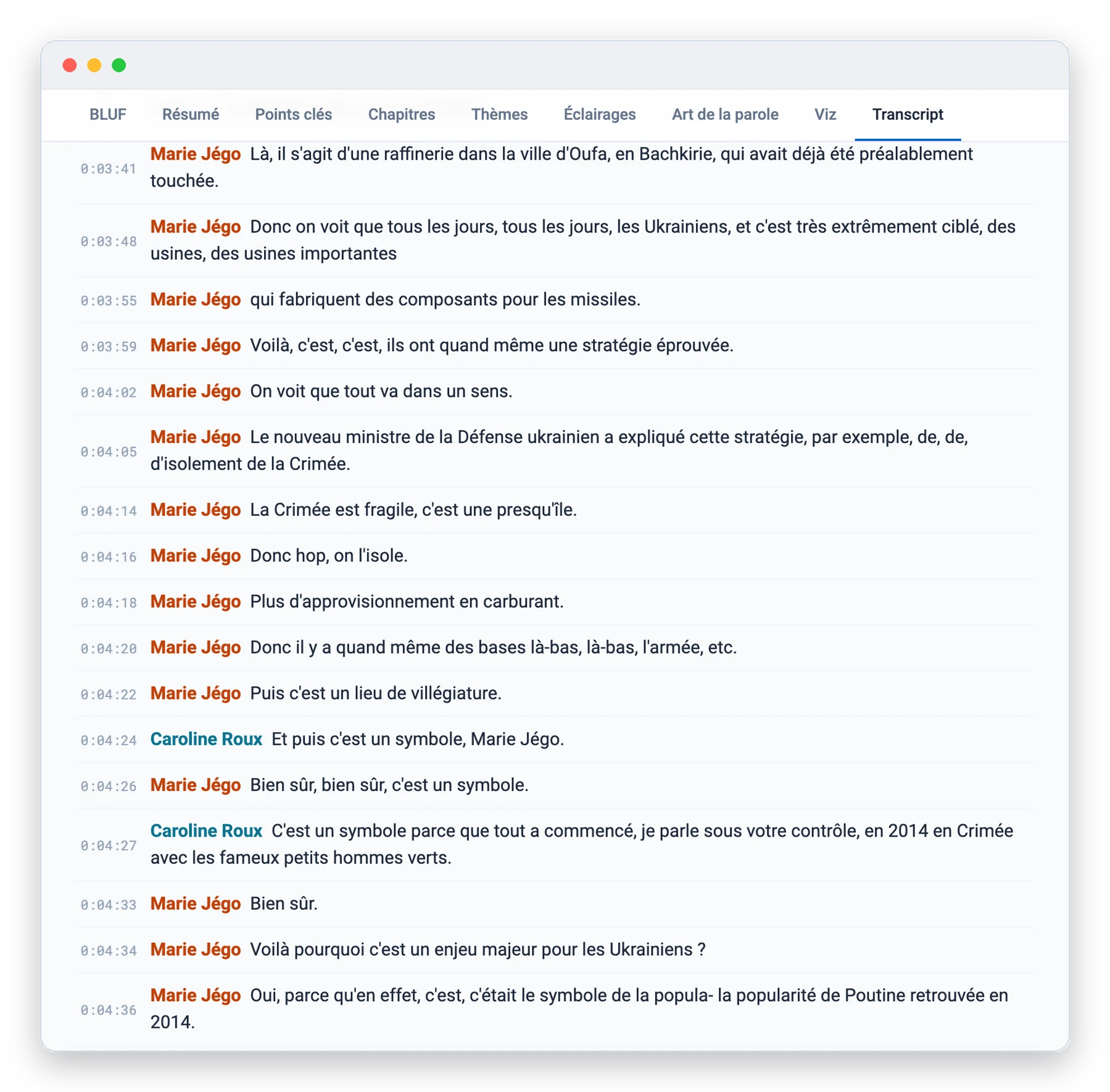
The transcript, speaker by speaker, with search and a per-voice filter. Every line starts with its moment in the video.
The same rule keeps the AI on a tight rein. Every judgement it makes, a stratagem, an agreement, a dodge, comes with the exact quote behind it and the moment it was spoken. No quote, and the code throws the judgement away. Nobody has to take the machine's word for it: anyone can go and listen to the sentence.
Not just who speaks: who cuts in on whom
Knowing who speaks when is not enough. What reveals a debate is who has the nerve to cut in. For every turn that starts while someone else is still talking, Mageiros measures the overlap, how hard the first speaker holds on, and what kind of turn comes in. A supportive “yes” or “mm-hm” does not count: it is a sign of listening, not an interruption.
In the March 20, 2026 episode of the No Priors podcast, Sarah Guo and Elad Gil host Andrej Karpathy, one of the fathers of modern AI. Sixteen minutes and thirty-three seconds, three voices, 55 interruptions. The knife marks who cuts in, the steak who gets cut off.
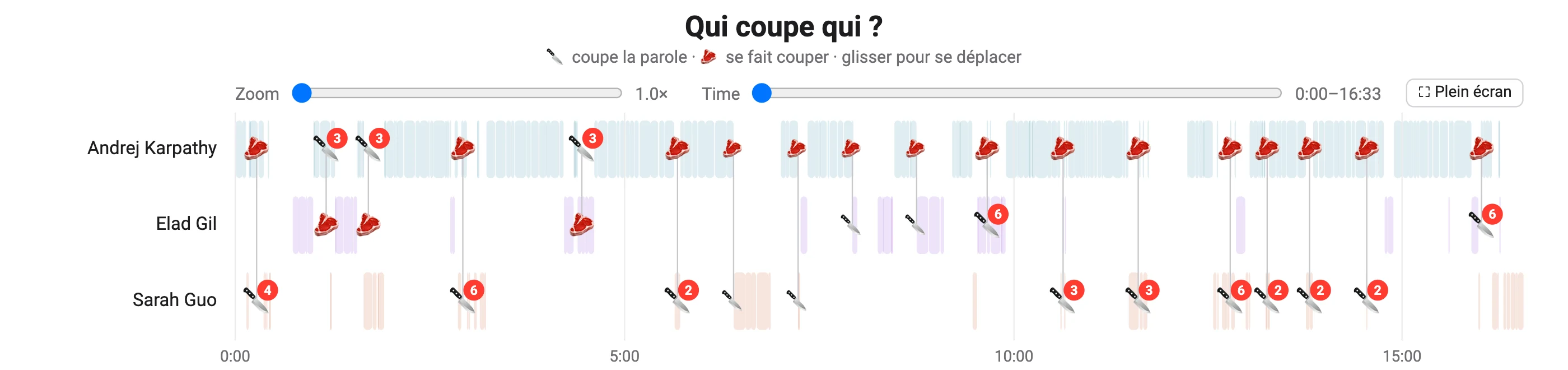
“Who cuts in on whom?”, the episode timeline as Mageiros draws it. In the record it zooms and pans with the mouse, and every mark leads back to its second.
Andrej Karpathy holds 69% of the floor, at 284 words a minute. His two hosts keep prompting him: Sarah Guo cuts in on him 20 times, Elad Gil 10 times. He cuts in on Sarah Guo 13 times. The cross-table sums up the conversation.
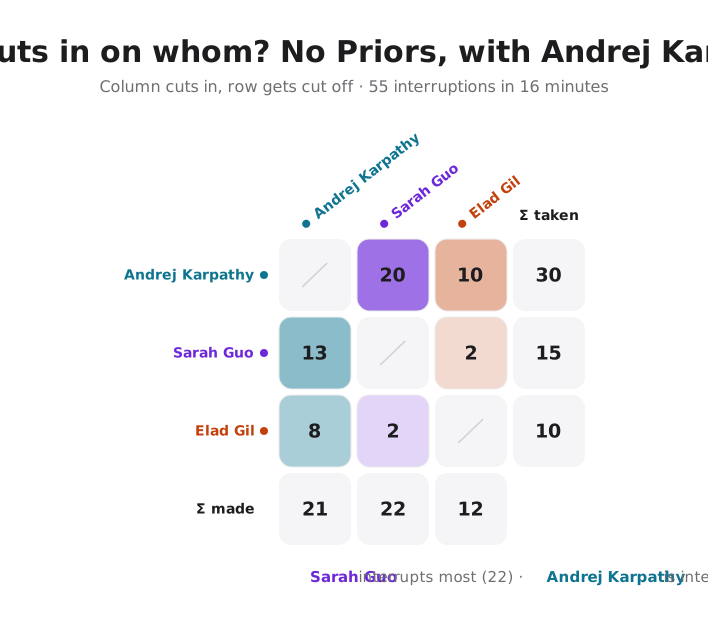
Each column counts the interruptions made, each row the interruptions suffered. Sarah Guo interrupts most, Andrej Karpathy is interrupted most: the nature of an interview podcast.
On the C dans l'air panel, Mageiros counts 107 interruptions in one hour. Caroline Roux makes 51 and suffers 49. That is no reproach: a host prompts, reframes, hands the floor to the next guest. It becomes one when a guest gets cut off twice as often as the others.
A number that stings deserves scrutiny. GAP-200 is a set of 355 interruptions marked by hand by human annotators. On it, Mageiros scores an F1 of 0.79 to 0.83. F1 combines both kinds of error, missed interruptions and false alarms; a score of 1 would mean perfect agreement with the annotators. The turn-taking geometry comes from linguistics research: Mattias Heldner and Jens Edlund on silences, Emanuel Schegloff on turn-taking.
Words per minute say just as much. They separate the speaker reeling off a pitch from the one searching for words, or the one speeding up to keep the floor.
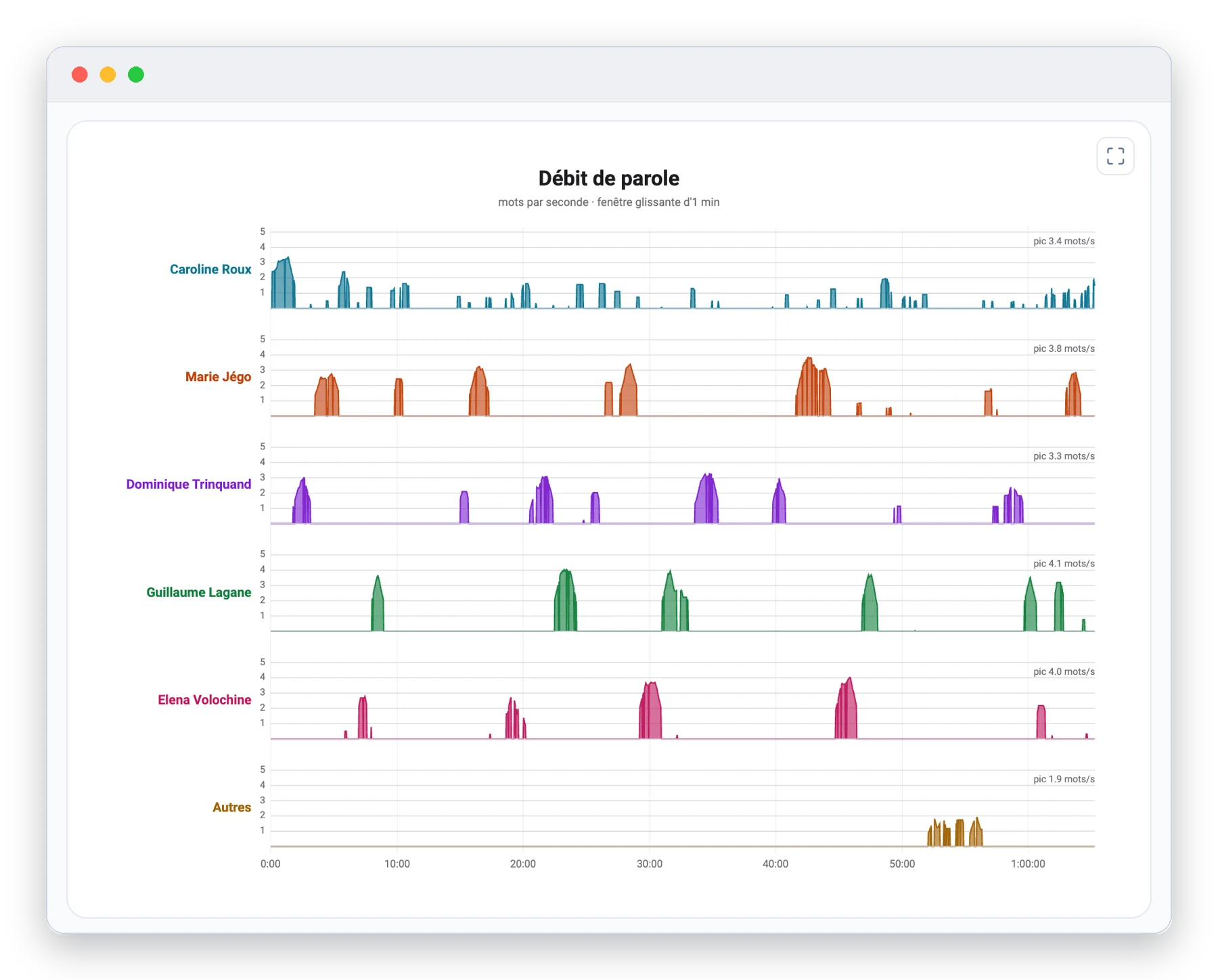
Each speaker's speaking rate, in words per second. The host's prompts run from the first minute to the last. The guests speak in blocks, some at close to 250 words a minute.
Women and men: the same airtime?
Two pieces of information are enough to see who dominates a debate: speaking time and gender. Mageiros estimates gender from the face, without touching identity, with a model that comes out of the French national audiovisual institute's research. It then crosses it with every speaking turn and every interruption.
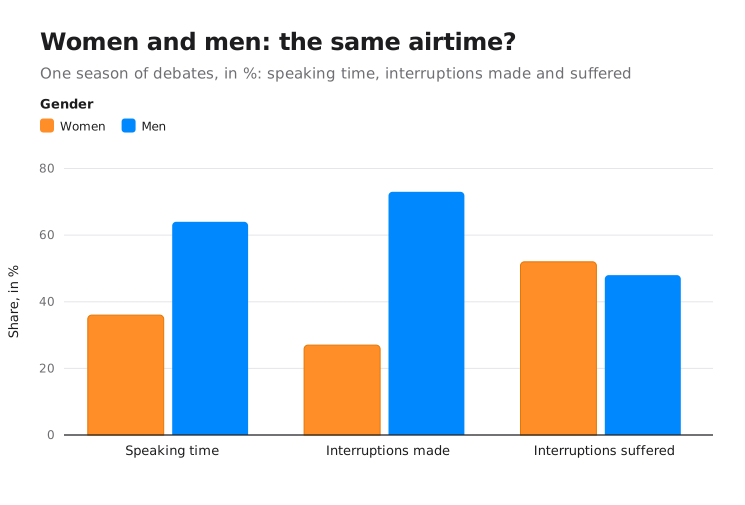
Over this season, women speak a little over a third of the time. They rarely cut in, yet suffer more than half the interruptions.
The same measurement extends to the balance of topics and to the political representation of guests: who gets invited to talk about what, then how long they are allowed to talk.
The art of being right, live
Around 1830, Arthur Schopenhauer listed 38 stratagems for winning an argument. The little treatise came out after his death as The Art of Being Right. What a find to reread it in front of a TV panel! Generalising from one case, posing a false choice, appealing to authority, pinning an odious label on the opponent: it is all there.
Mageiros spots these stratagems speaking turn by speaking turn. In the July 1 episode it finds 129. One example, at 22:20, Caroline Roux: “We agree that on the ground, Ukraine is advancing?” Schopenhauer calls this extracting consent through questions: the question already holds its answer.
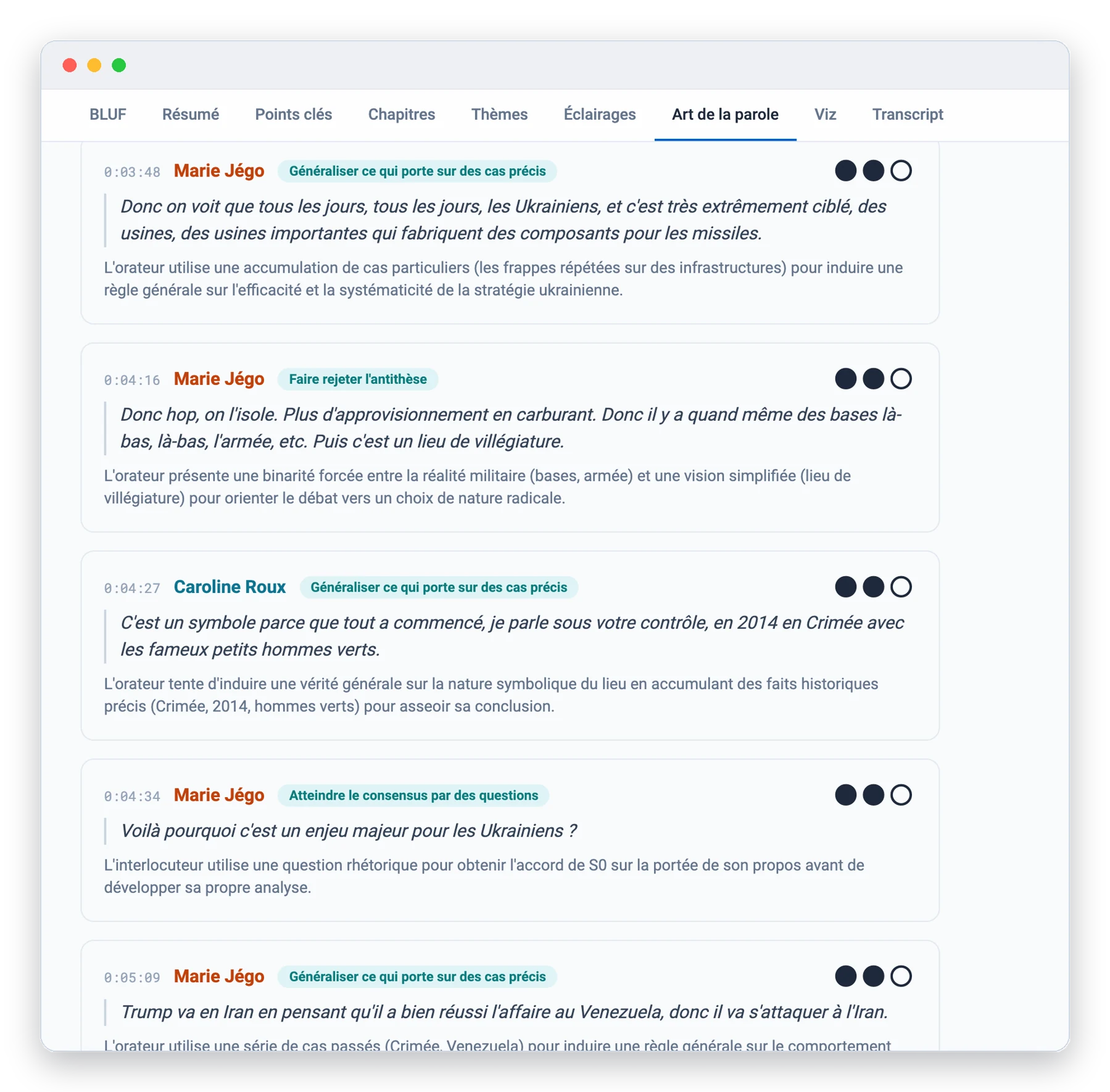
The Art of speech tab. Each card quotes the sentence, names the stratagem and explains how it works. While the video plays, the card for the current stratagem shows up live.
A stratagem describes the shape of an argument. It says nothing about the speaker's intent, let alone their sincerity. That is what makes it useful: you argue about the form, not the person.
What was discussed, and what do you need to know?
Mageiros splits every episode into chapters and themes. The July 1 episode has 13 and 57 respectively, from the front line to Russia's economic and social crisis. The Andrej Karpathy episode has 17 themes, from the “cognitive core” of small models to school after artificial general intelligence.
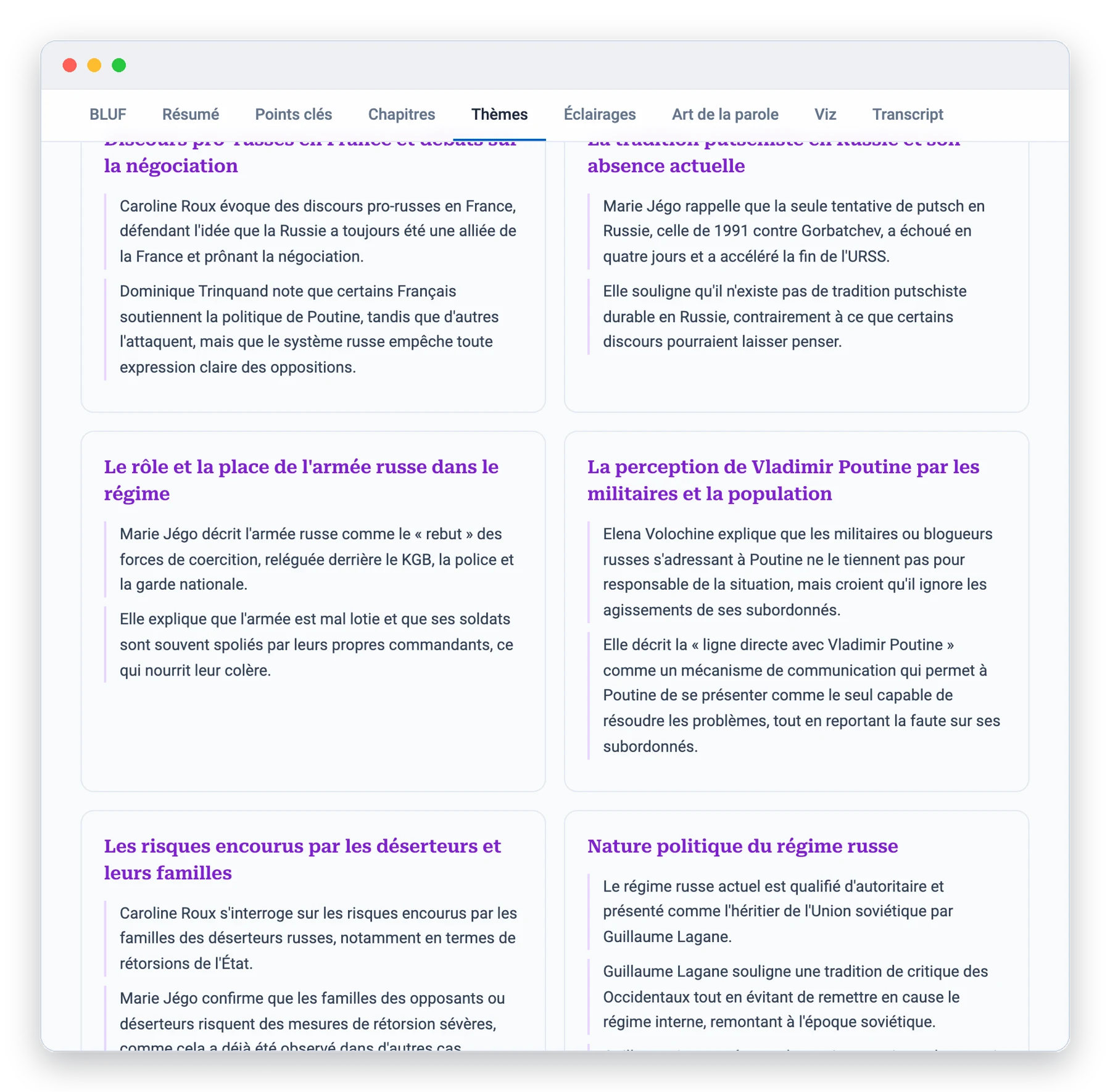
The Themes tab: each theme gathers its main points, each tied to the moment it was said.
Context notes go further. A panel assumes viewers know what an operation announced the day before is, or who wrote Software 2.0. Mageiros adds the missing context, drawn from the documents supplied with the episode: 12 context notes for C dans l'air, 6 for No Priors, from Eureka Labs to agent swarms. A note without a source is thrown away.
Over a season, themes tell the spirit of the times. How was this topic covered six months ago? Who was talking about it? The answer takes a minute.
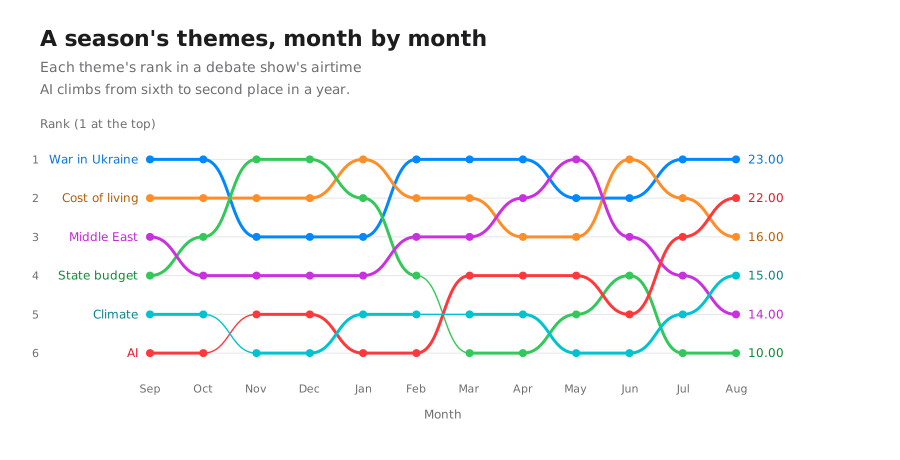
Each theme's rank, month by month. The news reads at a glance: the budget at year's end, AI on the rise.
What was being said when viewers left
Anyone who publishes video knows the retention curve: the share of the audience still there, second after second. It always has the same shape. A cliff in the first seconds, then a long glide. What matters is the gap with a typical video. Mageiros lays the show's topics over that curve: you see what was being said when viewers left, and when they stayed.

Your show, in blue, against a typical video of the same length, in grey. The opening cliff is the same for everyone: what follows is what separates good topics from bad ones.
Seeing is not proving. Viewers also leave because the show goes on, because a competing programme starts or because a guest wears them out. Mageiros sorts this out: it removes those effects and keeps only the topic's own. The result reads at a glance.

Left of the line, the topic keeps viewers; right of it, it drives them away. The report on sanctions makes almost twice as many people leave as usual.
More than the words, their meaning. A newsroom finally knows which topics hold its audience and which ones lose it.
Who agrees with whom, topic by topic
Two guests can agree on sanctions and clash on negotiations. A single agreement score flattens that nuance. Mageiros judges every pair of replies, agreement, disagreement or neutral, quote attached, then sorts the verdicts by topic.
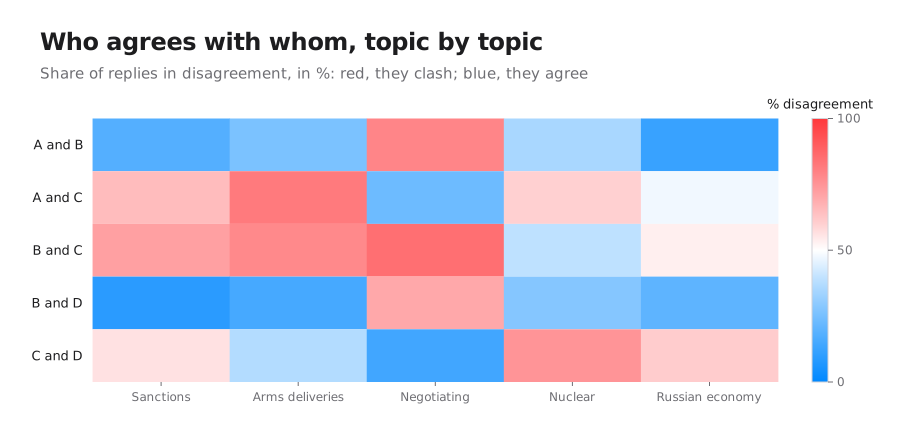
Each pair of guests' share of disagreement, topic by topic. One click on a cell opens the replies behind it.
Over a season, these verdicts draw camps. Mageiros groups people by their agreements and disagreements, measures how stable the camps are, and spots what crosses the line: the rare topics on which two opposing camps agree.
Who commits, who dodges
One simple test sorts it out: “OK, but how?” A sentence that names a cause or puts forward a concrete solution commits the speaker. An observation, a wish or a dodge does not. Mageiros classifies every speaking turn and names the dodges: the slippery soap, localism, dialogue sold as a solution, the story that replaces the answer, the admission of powerlessness, the reversed burden, the repeat.
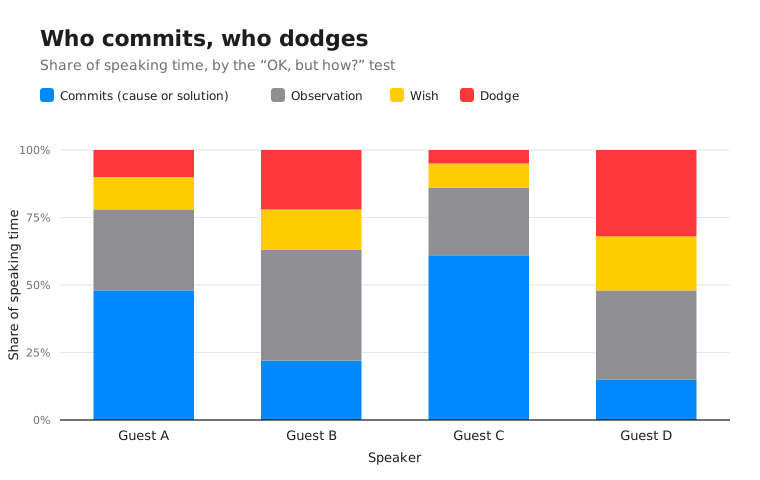
The share of speaking time that really commits each guest, then the share that dodges.
Talking points
On September 8, 2002, Condoleezza Rice, George W. Bush's national security adviser, said on CNN: “We don't want the smoking gun to be a mushroom cloud.” Two images in one sentence. On October 7, in Cincinnati, the president repeated it almost word for word to make the case for war on Iraq. The weapons of mass destruction were never found. The phrase had done its work.
That is a talking point: a sentence prepared to pass from mouth to mouth until it sounds like plain fact.
A three-to-eight-word formula that keeps coming back from one panel to the next, in the mouths of only a few people, does not happen by chance. Mageiros tracks these repeats across the whole corpus. It records who said the formula first, who picked it up next, and on which show. Everyday phrases are filtered out against a control corpus: “from a certain point of view” does not count.
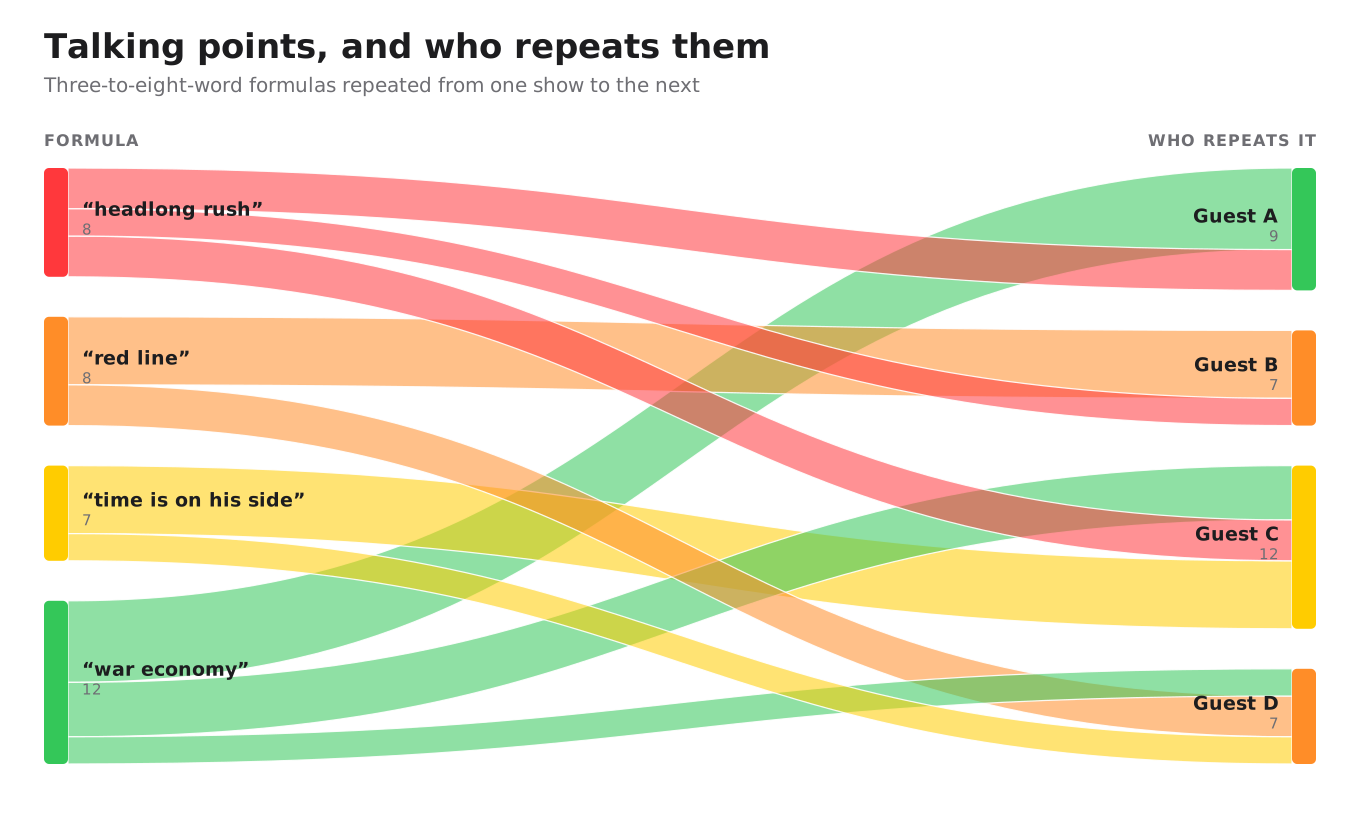
Four formulas and the people who repeat them from one show to the next. The width of each flow counts the repeats.
The same measurement answers another question: who talks like whom? Two people who use the same formulas move closer together. To rule out the echo of a single evening, Mageiros computes the likeness a second time, outside the panels they shared.
Who changed their mind?
From one episode to the next, positions shift. Some harden, others flip. Mageiros follows every person on the same questions, episode after episode. It shows the gap with the two quotes that prove it.
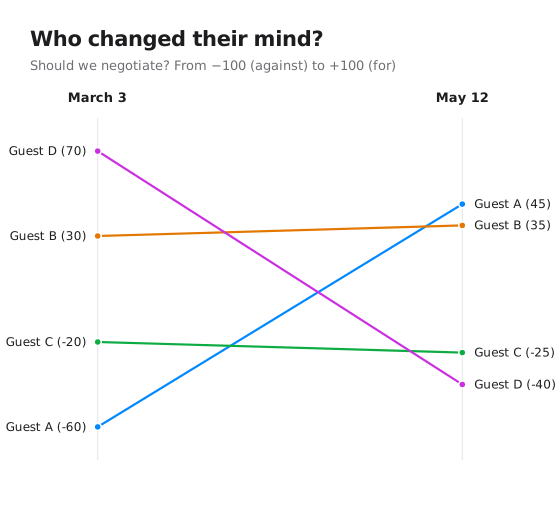
Should we negotiate? Two guests flipped between March and May, two held steady.
Every reply on the political map
Placing a person on a political map is labelling them. Mageiros places their replies. Every speaking turn gets a position on two axes: the economy, from state to market, then power, from libertarian to authoritarian. A person's cloud of dots shows both where they stand and how much they vary.
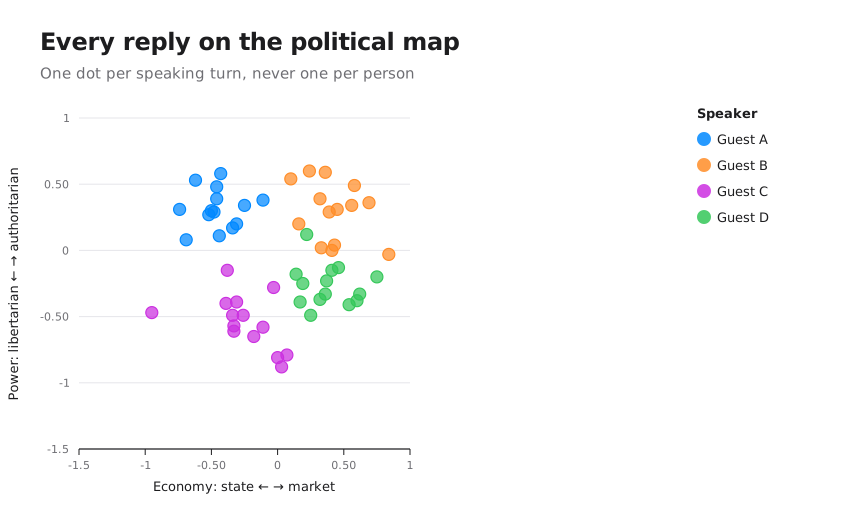
One dot per speaking turn, never one per person. A tight cloud means a position held; a spread cloud, speech that varies.
The French regulator's method as the reference
Arcom, the French audiovisual and digital communication regulator, replaced the former Conseil supérieur de l'audiovisuel in 2022. It publishes both its method for counting speaking time and its results. Mageiros counts by that method, so its numbers compare against a third party's rather than against themselves.
Runs on your machine or on French cloud and AI: your choice!
Locally, nothing leaves the computer. The only network traffic is the model download at first launch. An audit command fails as soon as a generated file calls an outside server. It runs on every change to the code.
The first reason is contestability. A measurement that only a paid vendor can redo is take-it-or-leave-it. This one recomputes for free, on an ordinary machine, with the same tool. Anyone who doubts a number rebuilds the episode and compares.
Or, your choice, the same analysis runs on French services: Gladia for transcription, pyannoteAI for who speaks when, Mistral for synthesis. Each call is billed once, then cached. The record names the engine that wrote it.
Call it the backup-generator philosophy. A hospital always keeps one, even on a reliable grid. Here, the local engine is that generator: if an outside service cuts access or changes its prices, everything keeps running on your side, in France or on your own servers.
A cost is money, energy and time. Mageiros measures all three for every episode it processes: a costed record, ready for a sustainability report. And the results arrive a few minutes after the closing credits.
Alone in the top-right corner
I compared Mageiros with sixteen media-analysis tools, from the Stanford and Internet Archive TV archives to the regulator's own counts, on eleven criteria scored from 1 to 5. Standpoint, another deraison.ai tool, turns that table into a positioning map: tools that resemble each other sit close, tools that differ drift apart.

Seventeen media-analysis tools placed by Standpoint. On the right, tools that analyse the voices on a panel; on the left, tools that analyse text. At the top, open, local and sourced; at the bottom, closed and hosted. Mageiros has its corner to itself.
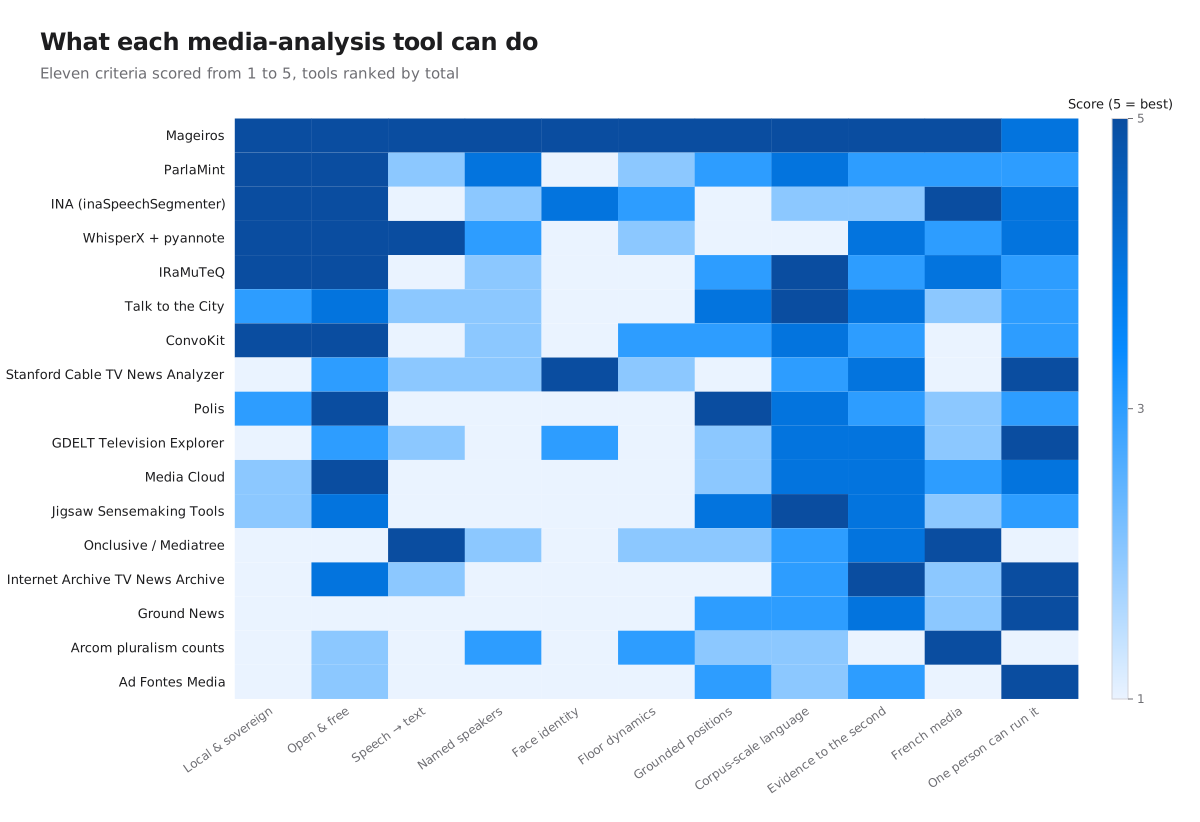
Seventeen media-analysis tools scored on eleven criteria, from local processing to second-level evidence. The darker the cell, the better the tool meets the criterion.
Each tool shines somewhere. The Stanford Cable TV News Analyzer recognises faces across years of airtime. Onclusive transcribes French media at scale. IRaMuTeQ analyses the language of a corpus. Each holds one cut of the animal. Mageiros is the only one that carves the whole of it:
- the only one to judge at the grain of the word and the reply, then build up to the season without losing the evidence;
- the only one to bring speech, identity, panel dynamics, rhetoric and causality together in a single record;
- the only one to tie every number to its second, one click away;
- the only one to run entirely on an ordinary machine, sending nothing to anyone.
The scores are mine. The detailed table, just above, can be challenged cell by cell.
For newsrooms, researchers and regulators
The current corpus covers a year of French public television, from August 2025 to August 2026, through three shows: C dans l'air on France 5, Cash Investigation and Quelle époque ! on France 2. The engine does not care where the sound comes from: a podcast, radio, the National Assembly or local television all go through the same pipeline.
Mageiros serves five audiences:
- A newsroom checks the balance of its panels before someone else does it for them.
- A social-science lab gets reproducible measurements over hours of airtime without transcribing anything by hand.
- A regional newsroom gets the same numbers for its own channel, with its own themes.
- A regulator or a watchdog gets a second, independent count, by the same method as the official one.
- A political party or a political-life observatory follows, show after show, who talks about what, for how long, with which phrases.
One engine at the centre, several ways to use it: an interface, a command line, an API or an AI assistant. It plugs into your tools instead of adding one more to maintain.
Start small, think big: we begin with one show, do it well, then widen. Want to see Mageiros take your own broadcasts apart? Let's talk.
The figures in this article were made with sprezzature.ai by Deraison.ai
 sprezzature.ai
 Deraison.ai